

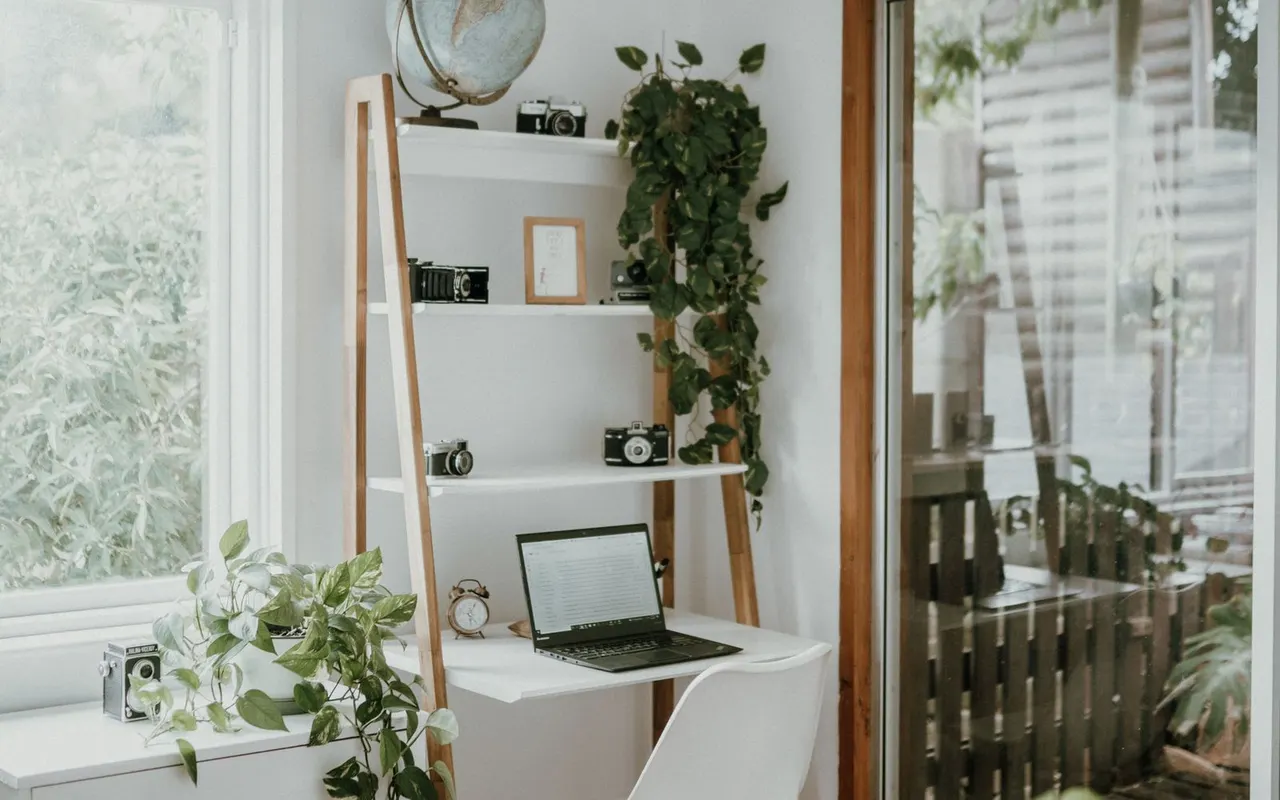
More people work from home than ever, often at a desk squeezed into a bedroom corner, a spare room or the end of the dining table. Feng shui has a lot to say about desks, and nearly all of it comes down to one question: which way should you face?
This guide answers that question in layers. First the layout rule that almost every school agrees on, then the compass-direction approach for those who want it, then practical solutions for small rooms, shared spaces and desks that can only go one way. I’ll also cover the chair, the desk surface and what goes behind you.
Key takeaways
- The most important rule: sit where you can see the door, without being directly in line with it, with a solid wall behind you.
- Facing a blank wall with your back to the door is the most common home office mistake.
- If you want to use compass directions, the Eight Mansions school suggests facing your Sheng Chi (success) direction, which comes from your Kua number.
- When the desk can only face a wall, a mirror that shows the door and a high-backed chair are the usual fixes.
- Keep the desk clear, the chair supportive and the space behind you solid.
The layout rule: face into the room
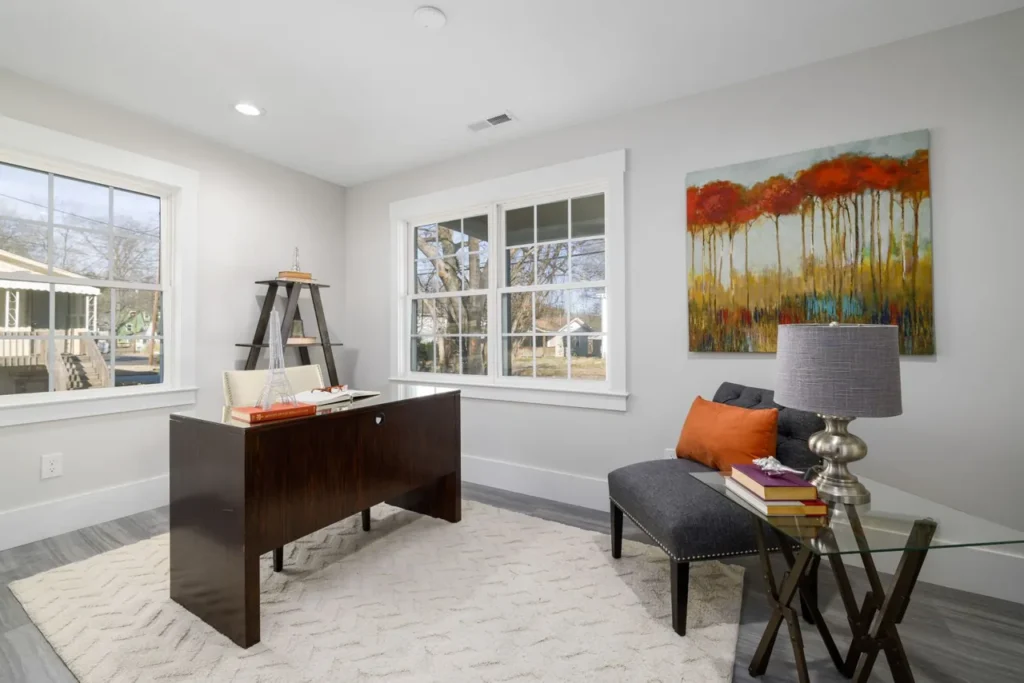
Feng shui calls the ideal desk position the command position. You sit facing into the room, with the door in view but not directly in front of you, and a solid wall at your back. The desk is often diagonally across from the door. I explain the principle and where it comes from in my guide to the command position; for a desk, it boils down to three checks:
- Can you see the door without turning your head?
- Are you out of the direct line of the doorway?
- Is there a wall behind you, rather than a window or the door?
The everyday logic is easy to recognise. People working with their backs to a door tend to feel startled when someone comes in. Facing into the room also gives you more to look at than a wall, and usually better light.
What should you face?
| Desk faces | Traditional view | Practical note |
|---|---|---|
| Into the room, door in view | Ideal: command position | Best for focus and calls |
| The door directly | Too exposed: energy comes straight at you | Distracting; move it to one side |
| A window | Mixed: pleasant, but some say thoughts “drift out” | Good light, but glare on screens |
| A wall, back to the door | Avoid: no view, back exposed | Common in small rooms; use a mirror |
| A wall, door to one side | Acceptable compromise | Better if you can see the door from the corner of your eye |
Compass direction: the Eight Mansions approach
For readers who want to go further, the Eight Mansions school gives each person four favourable directions based on their Kua number. For working, the usual advice is to face your Sheng Chi direction, linked with success and vitality, while sitting. You can find your number and directions with the Kua number calculator.
| Kua number | Sheng Chi (success) | Other favourable directions |
|---|---|---|
| 1 | Southeast | East, South, North |
| 2 | Northeast | West, Northwest, Southwest |
| 3 | South | North, Southeast, East |
| 4 | North | South, East, Southeast |
| 6 | West | Northeast, Southwest, Northwest |
| 7 | Northwest | Southwest, Northeast, West |
| 8 | Southwest | Northwest, West, Northeast |
| 9 | East | Southeast, North, South |
To check your facing direction, sit at the desk and take a compass reading straight ahead, holding the phone flat and away from metal and electronics. Unlike bed direction, which is about where your head points, desk direction is about the way you face.
If your Sheng Chi direction would put your back to the door, most practitioners would keep the command position and use one of your other favourable directions. It’s the same trade-off I describe for sleeping in my guide on which direction your bed should face.
When the desk can only face a wall
Small rooms, alcoves and bedroom corners often leave only one option. If your desk has to face a wall with your back to the door:
- Add a mirror on the wall or on the desk so you can see the doorway behind you. A small mirror beside the monitor is enough.
- Use a high-backed chair, which gives the “support” a wall would.
- Put something calming in front of you, such as a picture with depth, a pinboard of goals or a plant, so you’re not staring at a blank surface.
- Close the door while you work, if you can.
Desks in bedrooms
A desk in the bedroom brings work (yang) into a room meant for rest (yin). If you can’t avoid it, keep the desk as far from the bed as possible, avoid having it visible from the pillow, and put work away at the end of the day: close the laptop, cover the desk with a cloth or use a desk with a fold-down front. A screen or curtain between the desk and the bed helps in larger rooms. A desk that faces the bed is the arrangement most practitioners try to avoid.
When two people share a room, the options are:
- Side by side, both facing into the room, which is often the best feng shui choice if the room is wide enough.
- An L-shape, with each person on a different wall and both able to see the door.
- Facing each other across a double desk. Many practitioners discourage this as “confrontational”; a low divider or plants between the screens soften it.
- Back to back, which leaves at least one person with their back to the door and is usually avoided.
Working at the dining table or kitchen counter
Many people don’t have a desk at all. If you work at the dining table, choose the seat that gives you a view of the room’s main door with a wall behind you, and use that seat consistently, so the table has a “work end” and a “family end”. At the end of the day, clear everything into a box or bag and put it out of sight. That small ritual matters in feng shui terms, because it returns the table to its role as a place for meals, and it matters practically, because work left on the table tends to spread into the evening.
Kitchen counters and breakfast bars are harder, since you usually sit facing a wall or a window with the room behind you. A small mirror propped on the counter, or a stool with a back, goes some way to fixing that. If it’s a long-term arrangement, it’s worth looking for any corner of the home where a small desk could face into the room instead.
Cables, storage and the space under the desk
Feng shui treats the space under and around a desk the same way it treats the space under a bed: it should be clear, so energy and your legs can move freely. Boxes under the desk, a tangle of cables and a bin overflowing with paper all count as clutter at your feet. A cable tray or clips along the back of the desk, a closed drawer unit for paper and a small bin emptied daily make a noticeable difference to how the space feels. Keep reference books and files on a shelf beside you rather than stacked on the desk, and keep only the current task in front of you. Many people find that a clear desk at the start of the day makes it easier to begin work, which is feng shui’s point exactly.
The chair and what’s behind you
Feng shui puts a lot of weight on support behind you, so the chair matters. A solid, high-backed chair with arms is the traditional ideal. A stool or a backless seat is considered unsupportive for long work sessions. Behind the chair, a solid wall is best; a bookcase is fine if it’s not overloaded. A window or an open doorway behind you is the position to avoid.
The desk surface
You can apply the bagua to your desk, with you sitting at the “door” side. The far left corner is the wealth area, the far centre fame, and the far right relationships. A small plant on the far left, a lamp on the far centre and a photo of people you love on the far right are traditional choices. More practically, a clear desk with only today’s work on it is easier to focus at. My step-by-step guide to using the bagua map explains how the grid works.
Light, plants and the elements
Good light is essential for a desk. Natural light from the side is ideal, which avoids glare on the screen and shadows across the page. A desk lamp on the opposite side to your writing hand avoids shadows. A plant on or near the desk adds wood energy, associated with growth and creativity; my guide to the best feng shui plants by room includes desk-friendly options. A little metal (a white or grey desk tidy, metal frames) is associated with focus and order.
What practitioners emphasise
When I compared advice from different consultants for my roundup of home office feng shui recommendations, the points that came up most often were the same simple ones: see the door, have a wall behind you, keep the desk clear and get the light right. Direction came up less often than layout, which matches the order of priorities in this guide.
Frequently asked questions
Which direction should my desk face in feng shui?
Into the room with the door in view, not directly in line with it. If you use compass directions, face your Sheng Chi direction from your Kua number.
Is it bad to have your desk facing a wall?
It’s considered weaker, especially with your back to the door. A mirror that shows the door and a high-backed chair are the usual fixes.
Should my desk face a window?
Opinions are mixed. It’s pleasant, but some practitioners say it’s distracting. A window to the side is often the best compromise.
Can I have a desk in my bedroom?
Yes, but keep it away from the bed, out of view from the pillow, and put work away at the end of the day.
What should be behind my desk chair?
Ideally a solid wall. A window or open doorway behind you is the position most practitioners avoid.
What should I put on my desk for good feng shui?
A clear surface, good light and perhaps a plant on the far left (wealth) corner. Keep only current work on the desk.