

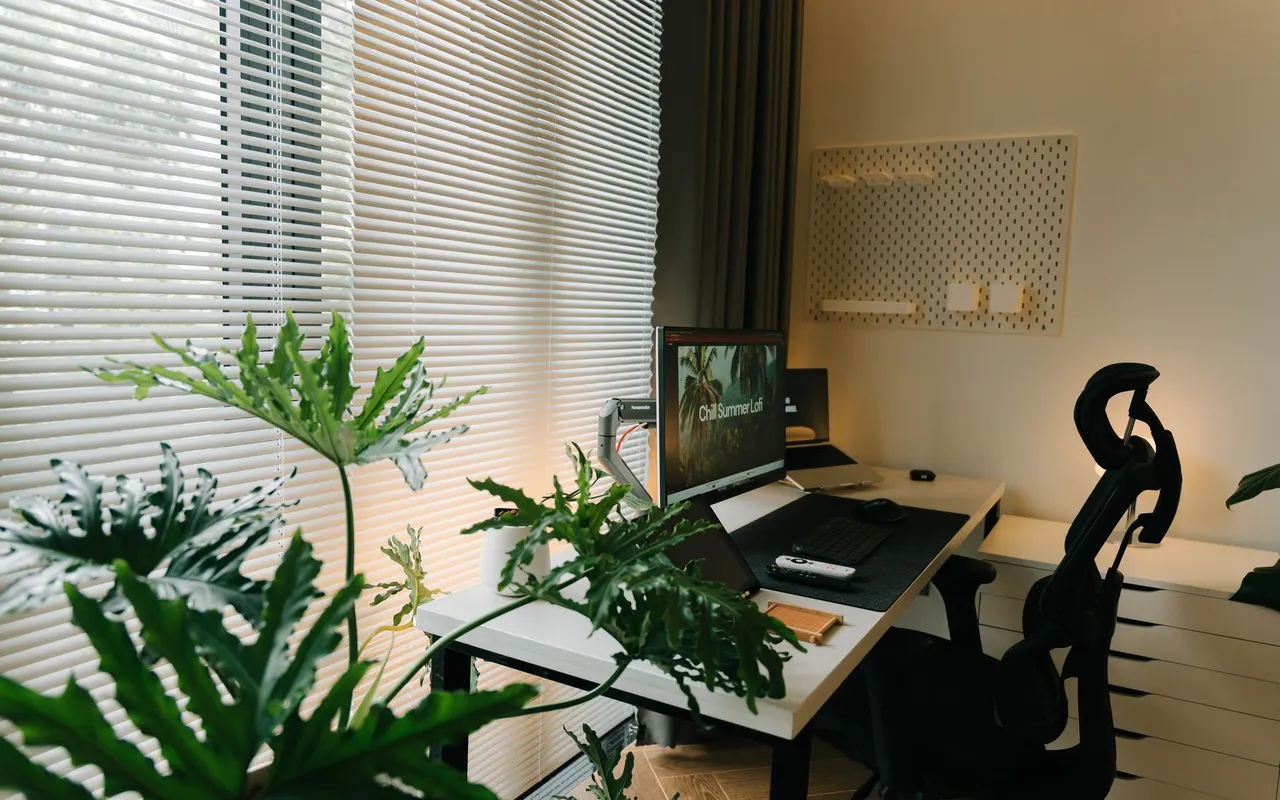
Working from home has turned the desk into one of the most-asked-about pieces of furniture in feng shui. The good news is that practitioners agree on the essentials, and they're all achievable in an ordinary flat. These seven guides are the ones I'd point a friend to.
Each one links to the original article. The summaries and comments are my own; the advice belongs to the authors.
How I chose these: each guide is written by a practitioner or a writer working with one, explains its reasoning, and is free to read. I have no business relationship with any of them, and none of them asked to be included.
1. The command position
By FengShui.info · fengshui.info. An independent feng shui reference site.
The clearest explanation I've seen of where the command position comes from: the classic landscape of a hill behind and open ground in front, scaled down from a grave site to a house to a chair. It also explains the four guardian animals indoors. Their summary that 'a desk facing a wall has no bird' sticks in the memory. I cover the same principle, applied to beds and stoves as well as desks, in my guide to the command position.
Best for: Readers who want to understand the principle, not just follow it.
Read “The command position” on fengshui.info
2. How to Feng Shui Your Work-From-Home Space
By Anjie Cho · Holistic Spaces. A New York architect and feng shui teacher.
Cho's first rule is simply to have a desk, or at least a dedicated space. If you work at the dining table, set it up properly in the morning and clear it away in the evening. It's realistic advice for small homes, and she explains the command position in plain terms.
Best for: Anyone working from a kitchen table or a corner.
Read “How to Feng Shui Your Work-From-Home Space” on Holistic Spaces
3. How do I Feng Shui my home office for success?
By Julie Britt · juliebritt.com. A feng shui consultant and author.
Three focused tips, starting with facing the door but offset from it. Britt explains the least favourable position (facing a wall with your back to the door) in terms of our 'primitive brain' staying on guard, a practical framing that makes sense even to sceptics.
Best for: Readers who like a short, reasoned read.
Read “How do I Feng Shui my home office for success?” on juliebritt.com
4. Home Office Feng Shui Tip: How to Choose the Best Desk
By Laura Cerrano · Feng Shui Manhattan. A New York consultant with more than 20 years of practice.
Most guides tell you where to put the desk; Cerrano is one of the few to help you choose one: a solid flat surface, ideally wood, and the right length, depth and height for your work. She illustrates it with her own office setup and explains why consultants advise against a desk facing a wall.
Best for: Anyone about to buy a desk.
Read “Home Office Feng Shui Tip: How to Choose the Best Desk” on Feng Shui Manhattan
5. Home Office Feng Shui & Productivity: Set Up Your Desk and Workspace
By Philip Yuen · Philip Yuen Feng Shui. A Sydney-based feng shui master.
The most modern guide here, covering desk orientation by compass direction, natural light and task lamps, cable management, plants, a video-call zone, sound and screens. It also includes an annual-focus section for 2026, which reflects the time-based side of classical feng shui. For the plants part, my guide to the best feng shui plants by room lists desk-friendly options for low office light.
Best for: Readers who spend hours on video calls.
Read “Home Office Feng Shui & Productivity: Set Up Your Desk and Workspace” on Philip Yuen Feng Shui
6. Desktop Feng Shui To Make Work Flow!
By Dana Claudat · The Tao of Dana. A feng shui consultant and long-time blogger.
Claudat shrinks the bagua to the size of your desk, with the row nearest you as the knowledge row and the far right corner for relationships, and suggests what to put in each area. It's a fun, practical idea for anyone who can't change where the desk is but can change what's on it. If the bagua is new to you, my step-by-step guide to using the bagua map explains the grid she is shrinking down.
Best for: People who can only control the desktop.
Read “Desktop Feng Shui To Make Work Flow!” on The Tao of Dana
7. Power Position, Elevated: Feng Shui for Your Desk & Office
By Alejandra Brady · Casa Shui Life. A feng shui and biophilic interior designer.
Brady combines the command position (with a small mirror if you can't see the door) with decluttering, including digital files, and with balancing the busy yang energy of screens with softer yin touches like a plant or rounded objects. She also maps the fame and career areas onto the desk, which pairs nicely with Claudat's approach.
Best for: Readers who want a calm, design-led workspace.
Read “Power Position, Elevated: Feng Shui for Your Desk & Office” on Casa Shui Life
Where they agree
- See the door from your chair, without sitting directly in line with it.
- A solid wall, or a high-backed chair, behind you.
- A stable, solid desk with a clear surface.
- Good light and at least one living thing in view.
Where they differ
The biggest split is whether the direction you face matters. Yuen, working in the classical compass tradition, assigns qualities to facing each direction, while Cho, Britt and Brady focus on seeing the door. If you'd like to try a personal direction, the Kua calculator shows the four the Eight Mansions school considers favourable for you.
The seven guides at a glance
| Guide | Main focus | Approach | Best starting point if… |
|---|---|---|---|
| FengShui.info | Origins of the command position | Explanatory | You want to understand the principle |
| Anjie Cho | Having a dedicated workspace | Realistic for small homes | You work at the kitchen table |
| Julie Britt | Three focused tips | Short and reasoned | You want a quick read |
| Laura Cerrano | Choosing the desk itself | Practical buying guide | You’re about to buy a desk |
| Philip Yuen | Direction, light, cables, calls and annual focus | Classical, modern workplace | You spend hours on video calls |
| Dana Claudat | The bagua on the desk surface | Playful, hands-on | You can’t move the desk |
| Alejandra Brady | Command position, decluttering, yin and yang balance | Design-led | Your workspace feels frantic |
Putting the advice together
Every guide here starts in the same place: where you sit relative to the door. Facing into the room with the door in view and a wall behind you is the shared ideal, and when the room won’t allow it, a small mirror and a high-backed chair are the shared fixes. I go through the full set of options, including desks in bedrooms and shared offices, in my guide on which way your desk should face. The principle behind it is explained in more depth in my command position guide.
After position, the guides converge on the desk surface and what surrounds it: a solid desk, a clear top, good light and at least one living thing. Claudat and Brady both map the bagua onto the desk, which is a useful idea if you can’t move the furniture; the method is the same as for a whole home, which my bagua map guide explains. For the plant, my plants-by-room guide has desk-friendly options for low office light.
Direction is the one real disagreement. If you want to follow Yuen and the classical compass approach, start with your Kua number and face your success direction, but most of the other six would tell you to keep the door in view first.
If you’re one of the authors featured here and would like a correction or to be removed, please use our contact page.