

The bagua map is the tool most people meet when they move beyond the basics of feng shui. It divides your home into nine areas, each linked with a part of life such as wealth, relationships or career, so you can decide where to focus attention. The idea is simple, but the instructions online often skip the steps that matter: which map to use, how to line it up, and what to do with a floor plan that isn’t a neat rectangle.
This is a step-by-step guide. I’ll explain the two main methods, how to draw and overlay the grid on your floor plan, what each of the nine areas represents, and how to handle irregular shapes, multiple floors and single rooms.
Key takeaways
- The bagua is a nine-area map (eight around a centre) based on the eight trigrams of the I Ching.
- There are two main ways to orient it: by the front door (Western or BTB) or by compass direction (classical). Choose one and stay with it.
- In the front door method, wealth is always the far left corner and relationships the far right, as you stand inside the door looking in.
- In the compass method, wealth is southeast, relationships southwest, career north and fame south.
- The bagua can be applied to a whole home, a single floor or a single room.
What the bagua is
The word bagua means “eight trigrams”. Each trigram is a set of three broken or unbroken lines from the I Ching, the ancient Chinese classic, and each is linked with a direction, an element, a family member and a part of life. Arranged around a centre, they form the octagonal bagua. Most modern practitioners simplify it into a three-by-three grid, which is easier to lay over a floor plan.
The bagua sits alongside the other core feng shui principles rather than replacing them. If you’re new to those, my overview of the basic principles of feng shui explains how the bagua fits with qi, yin and yang and the five elements.
Step 1: choose your method
This is the decision that causes most confusion, because the two methods often put the same area in different places.
| Front door (Western / BTB) | Compass (classical) | |
|---|---|---|
| How it’s oriented | The wall with the front door is the bottom of the grid | The grid is aligned to true compass directions |
| Where wealth is | Far left corner from the door | Southeast |
| What you need | A floor plan | A floor plan and a compass reading |
| Strengths | Simple, works the same in every home | Traditional, used with other classical methods |
| Common in | Popular Western books and websites | Classical schools and professional consultations |
Neither is “correct” in a way that settles the argument; they come from different traditions. If you’re following a book or teacher, use their method. If you’re starting from scratch, the front door method is easier to learn.
Step 2: get a floor plan
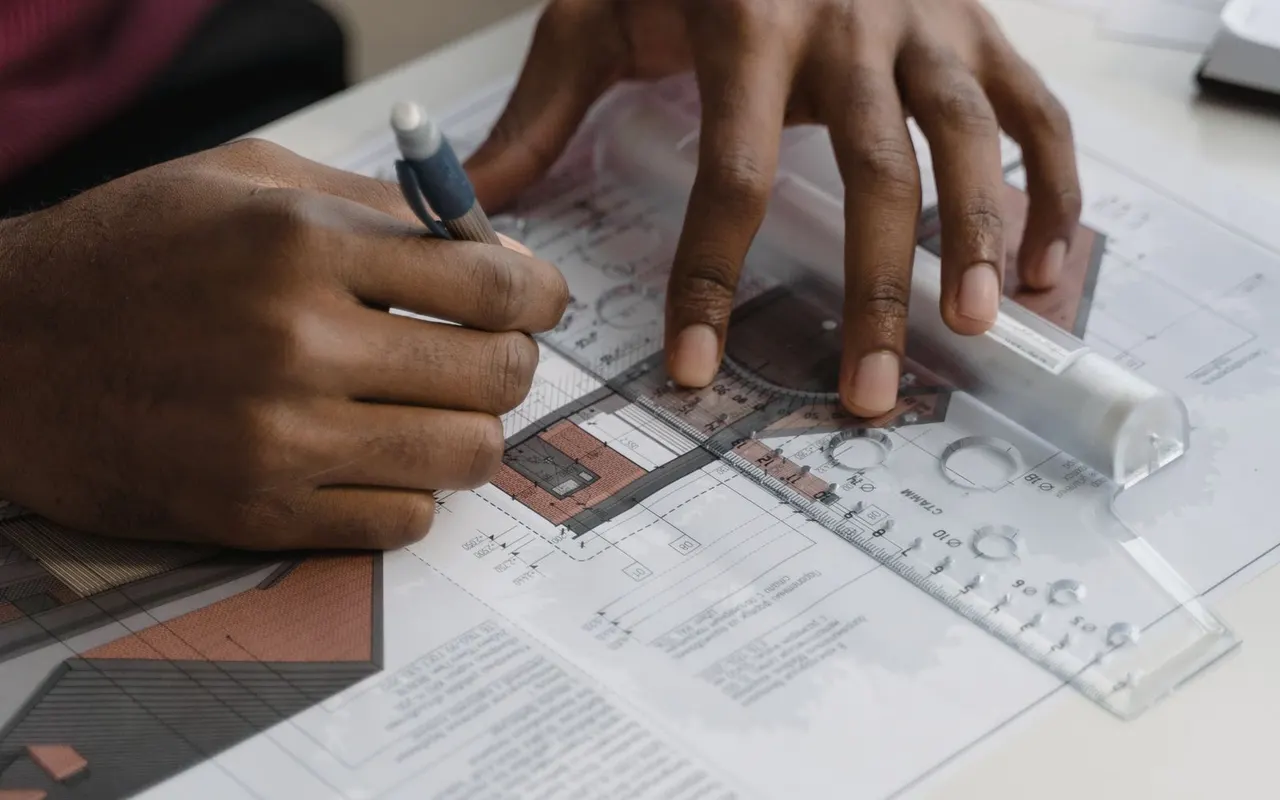
You need a reasonably accurate plan of your home from above. A plan from your estate agent or landlord is ideal. If you don’t have one, sketch it on squared paper: pace out or measure each room, mark the walls, doors and windows, and draw the outer outline of the whole home. Include attached garages or conservatories only if they’re part of the heated living space; most practitioners leave them out otherwise. Balconies and patios are usually left out of the main outline.
Step 3: draw the grid
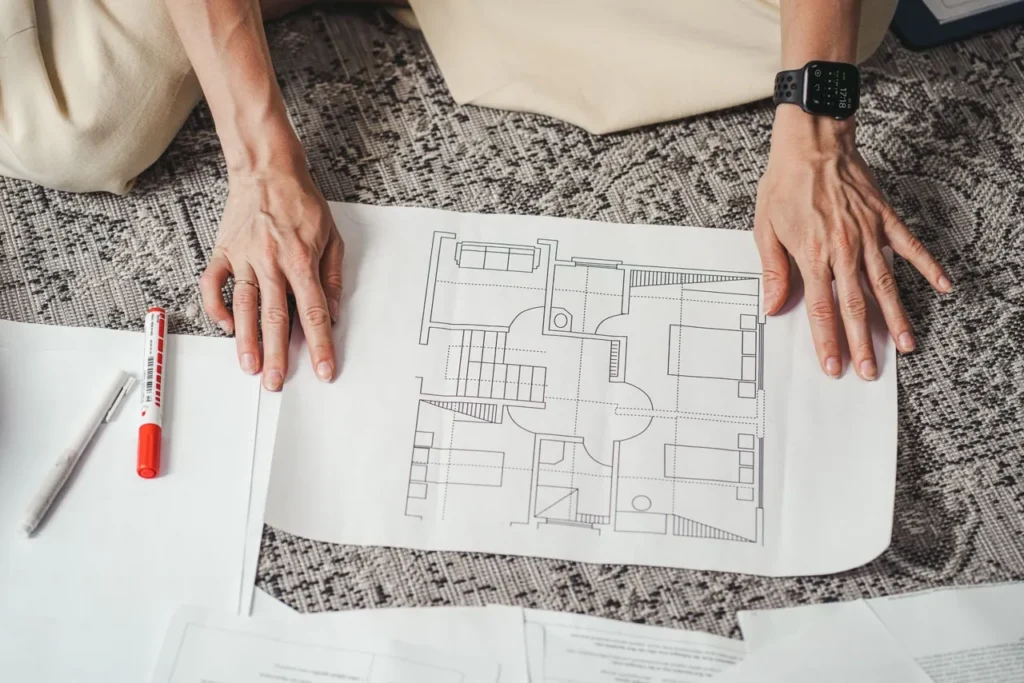
If you’d rather skip the drawing, the free bagua corner finder does the overlay for you once you tell it where your door is. To do it by hand, draw a rectangle around the outer edge of your home’s plan. Divide it into three equal columns and three equal rows, making nine sections. If your home isn’t a rectangle, draw the rectangle around its whole outer extent; some sections will fall partly outside the building. I’ll come back to that below.
Step 4: orient the grid
Front door method: turn the plan so the wall with your main front door is at the bottom. The door will fall in one of the bottom three sections: knowledge (left), career (middle) or helpful people (right). The far left section from the door is wealth and the far right is relationships.
Compass method: stand at the front door facing out and take a compass reading. Mark north on your plan, then label each of the nine sections by direction, with the centre in the middle. Wealth goes in the southeast section, fame in the south, relationships in the southwest, and so on.
Step 5: label the nine areas
Here’s what each area represents, with its traditional element and colours. The positions in the second column are for the front door method; the third column gives the compass direction for the classical method.
| Area | Front door position | Compass direction | Element | Traditional colours |
|---|---|---|---|---|
| Wealth and abundance | Back left | Southeast | Wood | Purple, green, gold |
| Fame and reputation | Back centre | South | Fire | Red, orange |
| Love and relationships | Back right | Southwest | Earth | Pink, red, white |
| Family and health of the household | Middle left | East | Wood | Green, blue |
| Centre (health, balance) | Centre | Centre | Earth | Yellow, earth tones |
| Children and creativity | Middle right | West | Metal | White, pastels |
| Knowledge and self-cultivation | Front left | Northeast | Earth | Blue, green, black |
| Career and life path | Front centre | North | Water | Black, deep blue |
| Helpful people and travel | Front right | Northwest | Metal | Grey, white, silver |
The elements matter because many bagua adjustments use the five element cycles: adding the area’s own element, or the one that feeds it. My guide to the five elements covers how that works.
Step 6: note what’s in each area
Walk through your home with the labelled plan and note what each area contains. Which rooms fall where? Is any area cluttered, dark, unused or in poor repair? Is there a bathroom in the wealth area or a storeroom in the relationship area? This survey is the most useful part of the exercise. It tells you where to put your effort first.
Irregular shapes and missing areas
In L-shaped, U-shaped and other irregular homes, one or more sections of the grid may fall outside the building. These are called missing areas. A common rule of thumb: if a part of the building sticks out by less than half the width of that side, it’s treated as an extension (a bonus); if a part is indented by more than half, it’s treated as missing.
Traditional fixes for a missing area include marking the outside corner where the walls would meet with a plant, light or stone, hanging a mirror on an inside wall that borders the missing area to “extend” it visually, and paying extra attention to that area in individual rooms. I go through these fixes for the most common case, a missing or awkward wealth area, in my guide to wealth corners in bathrooms, kitchens and missing spaces.
Multiple floors and single rooms
Multiple floors. Most practitioners apply the bagua separately to each floor, using the same orientation as the ground floor (the front door wall, or the same compass directions). On upper floors, some front door practitioners orient the grid to the top of the stairs instead; follow whichever your source uses.
Single rooms. You can lay the bagua over any room by treating its entrance door as the “front door”. This is very useful in flats, in shared homes where you only control your own room, and when a home-level area falls somewhere you can’t change. Your bedroom and your desk can each have their own wealth corner and relationship corner.
What to do with the map
Once you know where each area falls, the general approach is the same everywhere:
- Clear and repair first. An area full of clutter or broken things is the first thing practitioners address.
- Choose one or two areas to focus on. Pick the parts of life that matter most to you right now, rather than trying to enhance all nine.
- Add the area’s element and colours lightly. A plant in the wealth area, pairs and soft pinks in the relationship area, metal and grey in the helpful people area.
- Add a meaningful object if you like. Something that represents what you want from that area of life.
For specific ideas, my guides on finding the wealth corner and the northwest helpful-people area go into individual areas in more depth.
Common mistakes with the bagua
- Mixing methods. Using the front door method for one area and the compass method for another.
- Using a back or side door. The front door method uses the main entrance as designed, even if you mostly use another door.
- Ignoring the basics. Enhancing the wealth corner while the entrance is blocked and the bed is in line with the door.
- Overloading an area. Ten symbols in one corner is clutter, not an enhancement.
- Treating it as a guarantee. The bagua is a way of focusing attention on parts of your home and life, not a promise of outcomes.
Frequently asked questions
How do I use the bagua map?
Draw a three-by-three grid over your floor plan, orient it to the front door or to compass directions, label the nine areas, then clear and enhance the areas you want to focus on.
Which bagua method is correct?
Both are widely used. The front door method is simpler; the compass method is classical. Choose one and use it consistently.
What if my front door is in the middle of the wall?
Then it falls in the career area, which is common. If it’s on the left or right, it falls in knowledge or helpful people. All three are normal.
What is a missing area in feng shui?
A section of the bagua grid that falls outside your home’s walls, usually because of an L-shaped or irregular plan. It’s addressed by marking or “completing” the corner.
Can I use the bagua in one room?
Yes. Treat the room’s door as the front door and apply the grid to that room.
Does the bagua include the garden?
Usually not for the main map. Some practitioners apply a separate bagua to the garden, oriented to the garden entrance.