

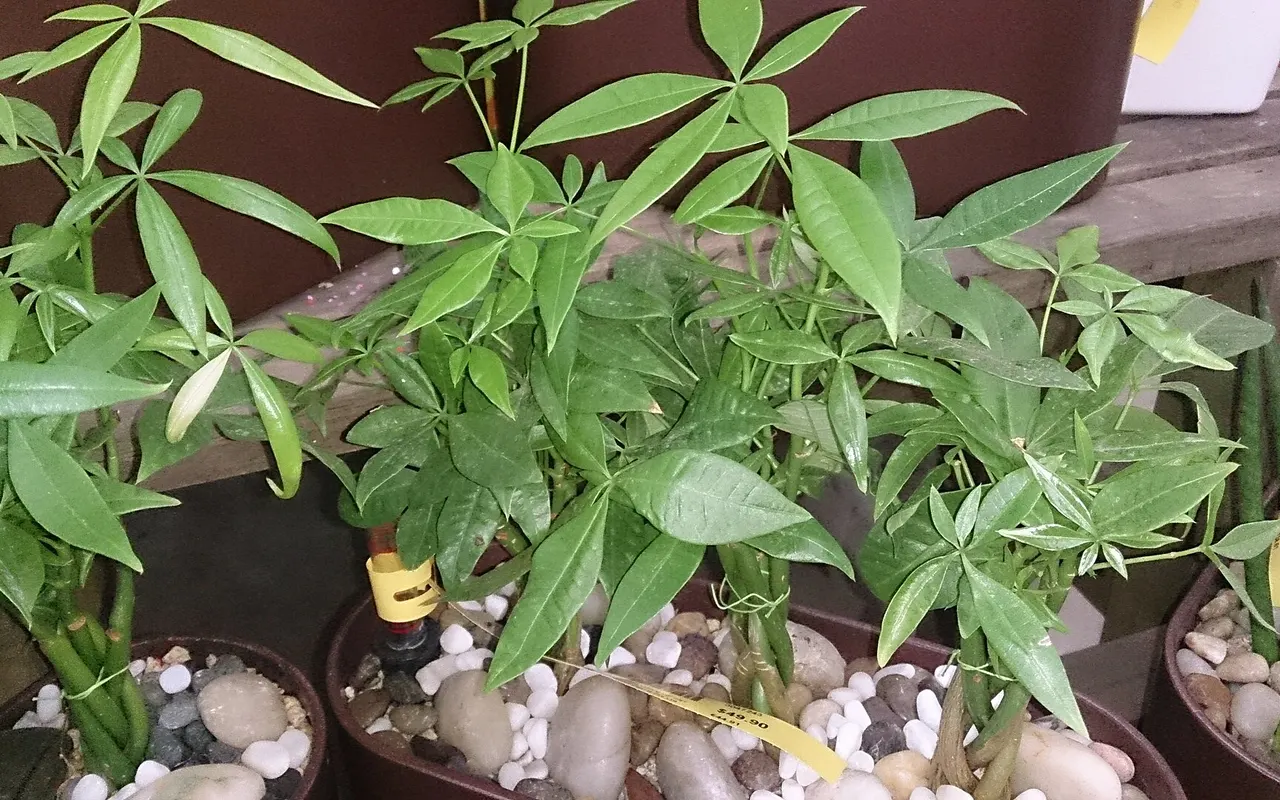
The money tree, Pachira aquatica, is the plant with the braided trunk and glossy, hand-shaped leaves you see in offices and garden centres, often with a red ribbon tied around it. In Taiwan, where the braided form became popular in the 1980s, it’s sold as a symbol of good fortune, and feng shui writers have adopted it as one of the classic plants for the wealth area of a home.
This guide covers where it’s traditionally placed, how to keep it healthy (a struggling plant undoes the symbolism), and how not to confuse it with the other plants that are also called “money plants”.
Key takeaways
- The traditional spot is the wealth area: the far left corner from the door (Western bagua) or the southeast (compass bagua).
- A living room corner, a home office or near the entrance (inside, not blocking the door) are also popular.
- Stems with five leaflets are considered especially lucky, matching the five elements.
- It likes bright, indirect light and dislikes soggy soil. Overwatering is the most common way to kill one.
- Don’t confuse it with the jade plant, the Chinese money plant (Pilea) or pothos, which are also sold as “money plants”.
Why the money tree is linked to wealth
The name and the symbolism go together. The plant belongs to the wood element, which governs growth and is tied to the wealth area of the bagua. Its leaves usually grow in groups of five leaflets, which is read as a nod to the five elements: wood, fire, earth, metal and water. A stem with seven leaflets is considered rare and extra lucky. Braiding several trunks together is said to “lock in” good fortune, though the braid itself is a growers’ technique rather than anything the plant does in nature.
Where to put a money tree
| Spot | Feng shui reasoning | Plant-care check |
|---|---|---|
| Wealth corner (far left from door / southeast) | The wood element in its home area | Needs bright, indirect light; avoid a dark corner |
| Living room | The room where the household gathers | Keep it away from radiators and cold drafts |
| Home office | Growth for work and income | Near a window but out of harsh afternoon sun |
| Near the entrance (inside) | Welcomes energy coming in | Don’t let it block the door or the path in |
| East | Wood element; family and health | Morning light suits it well |
The wealth corner
This is the classic placement. Using the Western (door-based) map, stand at the front door looking in; the wealth corner is the far left. With the compass method, it’s the southeast sector of the home. My guide to finding your wealth corner explains the difference, and the free bagua corner finder will map it for you. A small dish of coins or a glass of fresh water nearby is a common addition: in the five-element cycle, water feeds wood.
Home office
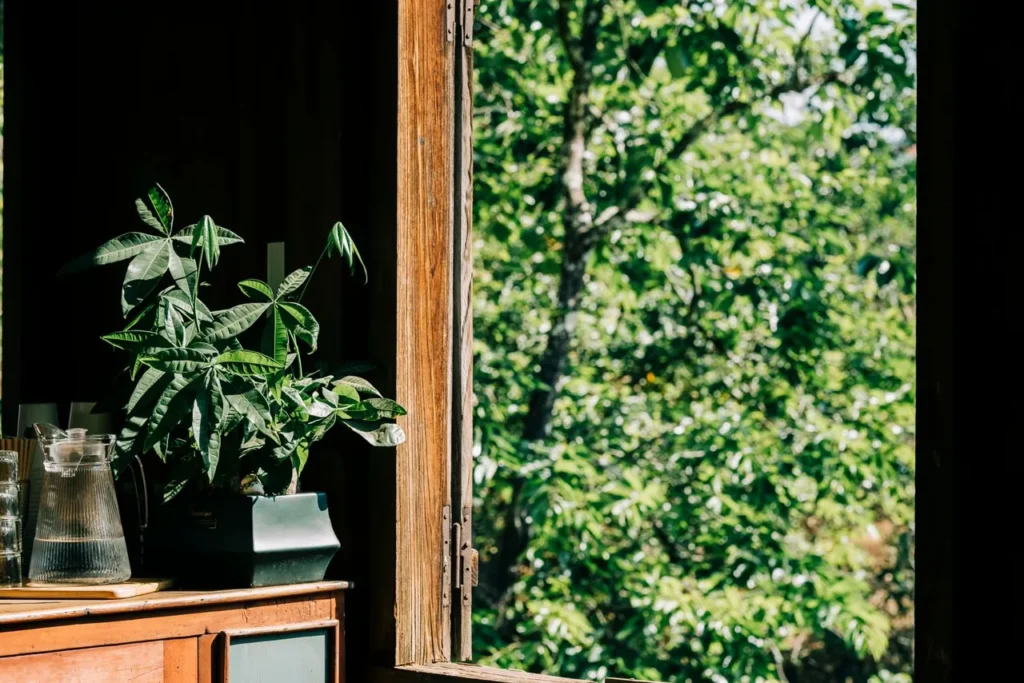
A money tree on the floor beside the desk, or a small one on a shelf, is a popular choice for anyone working from home. Try to place it where you can see it from your chair, and not directly behind you.
The living room
If your wealth corner is somewhere impractical, the living room is the next most popular spot. A large money tree in a corner softens the angle, which feng shui considers a sharp “poison arrow” pointing into the room, and fills a space that might otherwise collect clutter. Place it where it gets bright, indirect light and isn’t in the main walkway. If you’re arranging the whole room, my guide to arranging a feng shui living room covers seating and flow around plants like this one.
Near the entrance
A healthy plant inside the front door is a traditional welcome, and a money tree is a natural choice if the hallway has enough light. Put it to one side so it doesn’t block the door or the path. In a dark hall, a more tolerant plant is a better choice; a struggling money tree by the door sends the opposite message to the one intended.
Where to avoid putting one
- The bathroom, in feng shui terms, because energy and money are said to drain away there. Plant-wise, a bright bathroom is actually fine for a money tree, so this is a symbolic rule rather than a horticultural one.
- Dark corners. A plant that drops its leaves from lack of light works against the whole idea.
- Directly in front of the front door, where it blocks the way in.
- Next to a heater or air-conditioning vent, which dries the leaves.
Keeping your money tree healthy
Feng shui puts a lot of weight on living things being healthy, so care matters as much as placement.
- Light: bright, indirect light. A few hours of gentle morning sun is fine; strong afternoon sun can scorch the leaves.
- Water: water thoroughly when the top few centimetres of soil are dry, then let it drain. Never leave the pot standing in water. Yellowing leaves and a soft trunk usually mean too much water.
- Humidity: it’s a tropical wetland tree and appreciates some humidity. Occasional misting or a pebble tray helps in dry, heated rooms.
- Turning: rotate the pot now and then so it grows evenly.
- Pets: Pachira aquatica is listed as non-toxic to cats and dogs by the ASPCA, which is one reason it’s a popular houseplant.
What the braid and the ribbon mean
The braided trunk is a nursery technique: several young stems are planted together and woven as they grow. In feng shui writing, the braid is said to “lock in” good fortune, and five stems are the most common number, linked with the five elements. Braids of three are also sold. Four is usually avoided in Chinese tradition because the word sounds like “death”. The red ribbon added by many sellers is a traditional colour of good luck. It’s fine to keep it, but loosen or remove it as the trunk thickens, because a tight ribbon can cut into the bark.
Money trees alongside other wealth symbols
The money tree often shares the wealth corner with other symbols. A few simple combinations are popular: the tree with a small bowl of coins, the tree with a purple or green cushion nearby, or the tree with a money jar on a shelf beside it. Keep it to two or three things so the corner doesn’t feel crowded. For more ideas, my guide on what to put in your wealth corner covers the traditional choices and what to keep out. If you’re choosing between the money tree and other plants, my guide to the best feng shui plants by room compares options for different light levels.
Money tree, money plant, or Chinese money plant?
Several different plants share the “money” name, and placement articles often mix them up:
- Money tree (Pachira aquatica): braided trunk, hand-shaped leaves. The subject of this guide.
- Jade plant (Crassula ovata): a succulent with thick, coin-shaped leaves, also called the money plant or friendship tree.
- Chinese money plant (Pilea peperomioides): round, flat, pancake-shaped leaves on long stalks.
- Money plant in India and South Asia: usually golden pothos (Epipremnum aureum), a trailing vine.
The feng shui placement advice is broadly the same for all of them, since they’re all wood-element plants, but their care is very different.
Frequently asked questions
How many money trees should I have?
One healthy plant in the right spot is enough. Some people add a second in the home office.
What does it mean if my money tree is dying?
In plant terms, it usually means too much water or too little light. In feng shui terms, a dying plant should be revived or replaced, because wilting plants are seen as stagnant energy.
Should I keep the red ribbon on?
The ribbon is a good-luck decoration added by sellers. Keep it if you like it, but loosen it as the trunk thickens so it doesn’t cut into the bark.
Can a money tree go in the bedroom?
Some feng shui writers discourage large, energetic plants in bedrooms because the room is meant to be restful. A small plant is generally considered fine.
Featured photo: Mokkie, CC BY-SA 3.0, via Wikimedia Commons (cropped).