

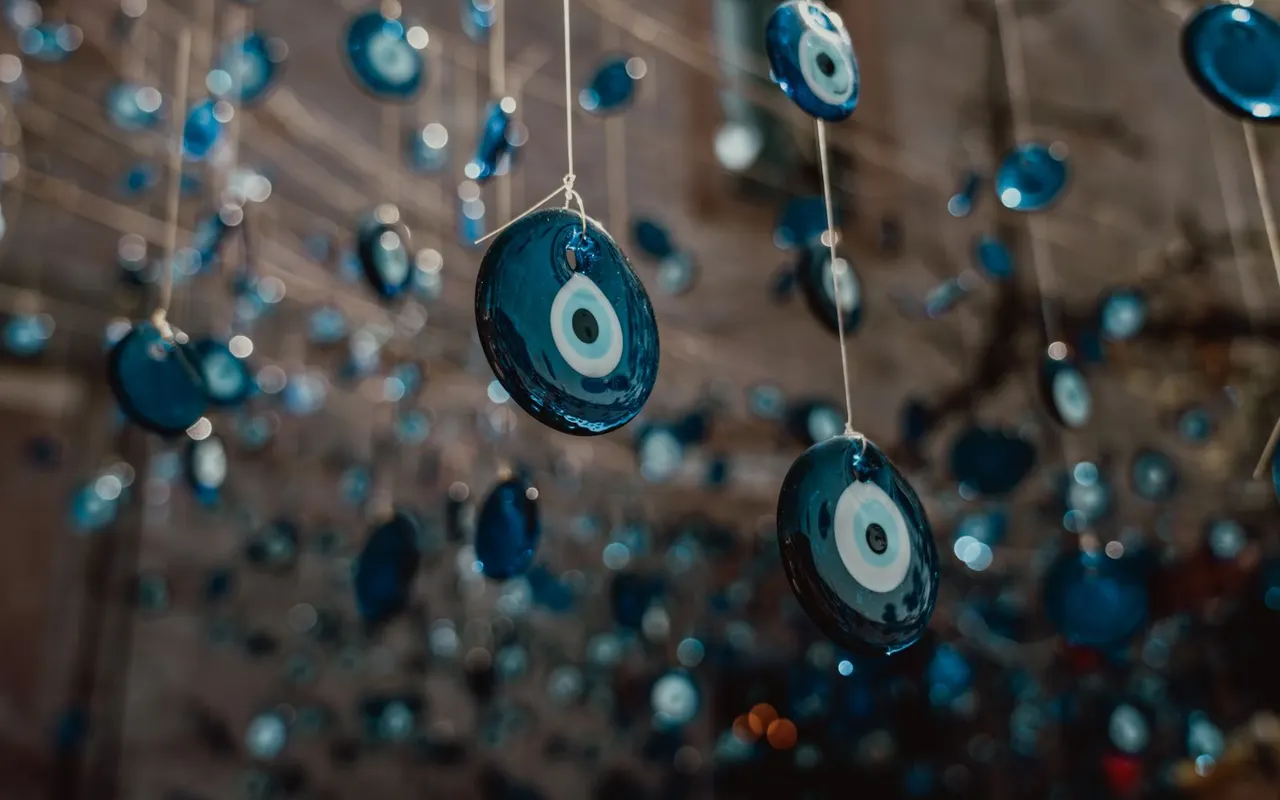
The blue glass eye you see hanging in doorways, cars and shop windows is one of the most popular protective charms in the world. It’s also one of the most frequent questions readers ask about feng shui. So it’s worth clearing something up first: the evil eye charm doesn’t come from feng shui. It comes from a much older belief found around the Mediterranean, the Middle East and South Asia, and modern feng shui writers have adopted it as a protective “cure”.
That doesn’t make it less meaningful. It just means the placement advice blends two traditions: the folk belief behind the charm, and feng shui ideas about doors, entrances and the way energy moves through a home. Here’s where it’s usually hung, and why.
Key takeaways
- The evil eye (often called a nazar) is a charm meant to deflect envy and ill will. It isn’t a classical feng shui object, but it’s widely used alongside feng shui cures.
- The most common spot is at or near the front door, where feng shui says energy enters the home.
- Living rooms, home offices and cars are also popular. Bedrooms are fine, but many people avoid hanging one where it “stares” at the bed.
- Tradition says a cracked or broken charm has done its job and should be replaced.
- Keep it clean and visible; a charm buried behind clutter is said to lose its effect.
What the evil eye charm is meant to do
The belief behind the charm is that envy or a resentful glance, the “evil eye”, can bring bad luck. The charm, usually concentric circles of dark blue, white and light blue glass, is meant to look back and deflect it. In Turkey and Greece it’s often given to new babies, to people moving into a new home or to someone opening a business.
In feng shui terms, writers tend to group it with other protective cures, alongside foo dogs by the entrance or a bagua mirror outside the door. The common thread is guarding the thresholds where outside energy comes in.
The best places to hang an evil eye
| Spot | Why it’s chosen | Placement tip |
|---|---|---|
| Front door (inside) | The “mouth of chi” in feng shui; the first line of protection | Hang it at or above eye level, facing the door |
| Front door (outside) | Greets visitors before they enter | Above or beside the frame, out of the weather if it’s glass |
| Entry hall or foyer | Catches anyone who passes through | On a hook, the wall or a console |
| Living room | Where guests gather and spend time | Somewhere visible, not tucked behind objects |
| Home office or desk | Protection for work and reputation | Near the door or within sight from your chair |
| Car | Protection while travelling | From the mirror only if it doesn’t block your view |
| Child’s room | The traditional gift for babies | Out of reach; glass beads are a choking hazard |
The front door
If you only hang one, this is the place. Feng shui treats the front door as the point where energy, and people, enter, so a protective charm there is meant to filter what comes in. Many people hang it on the inside of the door facing outward, so the “eye” looks at whoever arrives. Others prefer a small charm outside above the frame. Either is fine; what matters most in tradition is that it’s visible and faces the entrance.

The living room
The living room is where visitors spend the most time, which is why it’s the second most common choice. Hang it where it can be seen from the seating area, or on a wall facing the room’s entrance.
The bedroom
Opinions split here. Some people like a small evil eye near the bedroom door as a guard for the room you sleep in. Others feel an “eye” watching the bed undermines the restful mood feng shui aims for in bedrooms, the same reasoning used against mirrors facing the bed. A practical middle ground is to hang it near the door rather than opposite the pillows.
Where people usually avoid hanging one
- In the bathroom. Feng shui treats bathrooms as rooms where energy drains away, so protective objects are rarely placed there.
- Behind clutter or inside a drawer. The charm is meant to be seen.
- Directly facing the bed. See the bedroom note above.
- Broken or cracked. Folk belief says the charm cracked because it absorbed something harmful; the custom is to thank it and replace it.
The evil eye alongside other protective symbols
Because the evil eye has been adopted into feng shui rather than coming from it, people often wonder whether it “clashes” with traditional Chinese protective symbols. Most modern practitioners see no conflict, and many homes use the evil eye inside the door with a pair of guardian lions outside. A few points help them sit well together:
- Give each its own job. Guardian lions traditionally stand outside, either side of the door, facing out. The evil eye hangs inside, facing the door. Neither needs to be duplicated.
- Don’t crowd the entrance. One charm, a pair of lions and perhaps a plant are plenty. An entry hung with five protective objects starts to feel anxious rather than welcoming.
- Keep the basics right. A protective charm hung in a dark, cluttered hallway is working against its surroundings. A clear, lit entry is the first protection feng shui recommends.
If you’re deciding which symbols to use at all, my placement table for 15 common feng shui symbols sets out where each traditionally goes and which way it faces.
Awkward entrances and the evil eye
People often reach for a protective charm when the entrance feels “wrong”: the door opens straight onto the stairs, lines up with the back door, or faces a wall a step away. A charm can be a reassuring addition, but practitioners would usually deal with the layout first, using rugs, lighting, plants and furniture to slow and soften the space. I’ve set out those fixes in my guide to front doors facing stairs, a wall or the back door. Once the entry feels calmer, the evil eye can go where it naturally fits: visible, at eye level, facing the door.
In a flat, hang the charm inside your own front door rather than in a shared corridor, which may not be allowed and isn’t yours to protect. In a shared house, your bedroom door is the natural spot. At work, a small charm on or near your desk, within sight from your chair, is the usual choice; some people prefer a discreet bead on a keyring or bracelet where a visible charm wouldn’t suit the office.
Giving an evil eye as a gift
In Turkey, Greece and much of the Middle East, an evil eye is a traditional gift for a new baby, a new home, a wedding or a new business, and many people believe a charm received as a gift carries more meaning than one bought for yourself. If you’re giving one, choose the traditional blue, include a short note on where it’s usually hung, and for a baby choose a version designed to hang out of reach, since glass beads are a choking hazard.
Colours and forms
The classic charm is dark blue with a white and light blue centre, and that’s the version most traditions mean when they talk about the evil eye. Modern versions come in other colours, often with meanings attached by sellers (green for health, red for courage and so on). Those colour meanings are a recent marketing layer rather than an old tradition, so if you want the traditional object, choose blue.
The charm comes in many forms: a glass disc on a cord, a bead on a bracelet, a hamsa (an open hand) with an eye in the palm, or a large glass plate for the wall. In feng shui writing, form matters less than placement and visibility.
Looking after it
Dust it now and then and keep it where it can be seen. Some people “cleanse” charms with sunlight or by rinsing them in water, following general feng shui practice for protective objects. Those rituals are personal rather than required.
Frequently asked questions
Is the evil eye a feng shui symbol?
Not originally. It comes from Mediterranean, Middle Eastern and South Asian folk tradition. Feng shui practitioners have adopted it as a protective cure because it fits the same idea of guarding doors and entrances.
Should the evil eye face in or out?
Traditionally it faces toward whoever is approaching, so near a front door it usually faces the door or the outside. Indoors, hang it where it looks toward the room’s entrance.
What does it mean if my evil eye breaks?
In folk belief, a cracked charm has absorbed negative energy and done its job. People usually replace it with a new one.
Can I have more than one?
Yes. Many homes have one at the front door and others in a car, office or child’s room. There’s no traditional limit, though one clearly visible charm per area is enough.