

Most of us don’t get to choose which way our front door faces. But if you’re house-hunting, planning an extension, or just curious about what feng shui says about the door you have, the direction question comes up quickly. Classical feng shui attaches meaning to each compass direction, and some approaches go further and match the door to the people who live behind it.
This guide explains how to measure your front door’s direction properly, what each of the eight directions is traditionally associated with, how the Kua number approach works for doors, and which colours suit each direction. Most importantly, it covers what to do if your door faces a direction you’d rather it didn’t, because that’s the situation most people are in.
Key takeaways
- Door direction is measured standing inside the doorway, looking out. That’s the “facing” direction.
- No direction is bad in itself. Each is linked with an element and an area of life.
- In the Eight Mansions approach, a door that faces one of the household’s favourable directions is considered supportive.
- Door colour is often chosen to suit the element of the facing direction, or the element that feeds it.
- A well-kept, well-lit, easy-to-find door matters more than its direction in nearly every school.
How to measure your front door’s direction
Stand just inside the open front door, facing out, with your back to the house. Hold a compass or phone flat at waist height and note the reading. Step a little way out and take a second reading to check that metal in the door frame isn’t affecting it. That reading is the direction the door faces. If your phone compass offers “true north”, use it; classical practitioners generally work from magnetic readings taken on site, but for this purpose the difference is small in most places.
Feng shui divides the compass into eight sectors of 45 degrees each:
| Direction | Degrees |
|---|---|
| North | 337.5 to 22.5 |
| Northeast | 22.5 to 67.5 |
| East | 67.5 to 112.5 |
| Southeast | 112.5 to 157.5 |
| South | 157.5 to 202.5 |
| Southwest | 202.5 to 247.5 |
| West | 247.5 to 292.5 |
| Northwest | 292.5 to 337.5 |
For flats, most practitioners use the door of your own apartment for interior questions, and the building’s main entrance for questions about the building as a whole.
What each direction is associated with
Each direction carries an element and an area of life from the bagua. These associations come from classical feng shui and are fairly consistent across sources:
| Door faces | Element | Area of life | Traditional character |
|---|---|---|---|
| North | Water | Career, life path | Quiet, steady; often described as calm and reflective |
| Northeast | Earth | Knowledge, self-cultivation | Studious, grounded |
| East | Wood | Family, health | Morning sun, growth, new beginnings |
| Southeast | Wood | Wealth, abundance | Steady growth; popular in wealth-focused advice |
| South | Fire | Fame, reputation | Bright, warm, outgoing |
| Southwest | Earth | Relationships, partnership | Nurturing, stable |
| West | Metal | Children, creativity | Afternoon sun, enjoyment |
| Northwest | Metal | Helpful people, travel | Leadership, support from others |
Popular guides sometimes rank directions, with south or southeast often called “best”. Classical practitioners generally don’t; a direction’s suitability depends on the household and on more advanced methods such as the Flying Stars, which look at the building’s age as well as its facing.
The Kua number approach
In the Eight Mansions school, each person has four favourable and four unfavourable directions based on their Kua number. A front door facing one of the main earner’s favourable directions, particularly their Sheng Chi (success) direction, is considered supportive. East group people (Kua 1, 3, 4, 9) have favourable directions north, south, east and southeast; West group people (Kua 2, 6, 7, 8) have west, northwest, southwest and northeast. You can find your number with the Kua number calculator.
Because households mix East and West group members, and because you rarely choose your door, this approach is used mainly for house-hunting or for choosing which of several entrances to use as the main one.
Door colours by direction
Painting the front door is one of the most popular feng shui changes, and door colour is usually chosen by the element of the facing direction. You can use the direction’s own element or the element that feeds it in the productive cycle. My guide to the five elements explains those cycles.
| Door faces | Element | Colours of the element | Supporting colours | Often avoided |
|---|---|---|---|---|
| North | Water | Black, dark blue | White, grey, metallic (metal feeds water) | Yellow, earth tones |
| East, Southeast | Wood | Green, natural wood | Black, dark blue (water feeds wood) | White, metallic |
| South | Fire | Red, orange | Green (wood feeds fire) | Black, dark blue |
| Southwest, Northeast | Earth | Yellow, sand, terracotta | Red, orange (fire feeds earth) | Green |
| West, Northwest | Metal | White, grey, metallic | Yellow, earth tones (earth feeds metal) | Red |
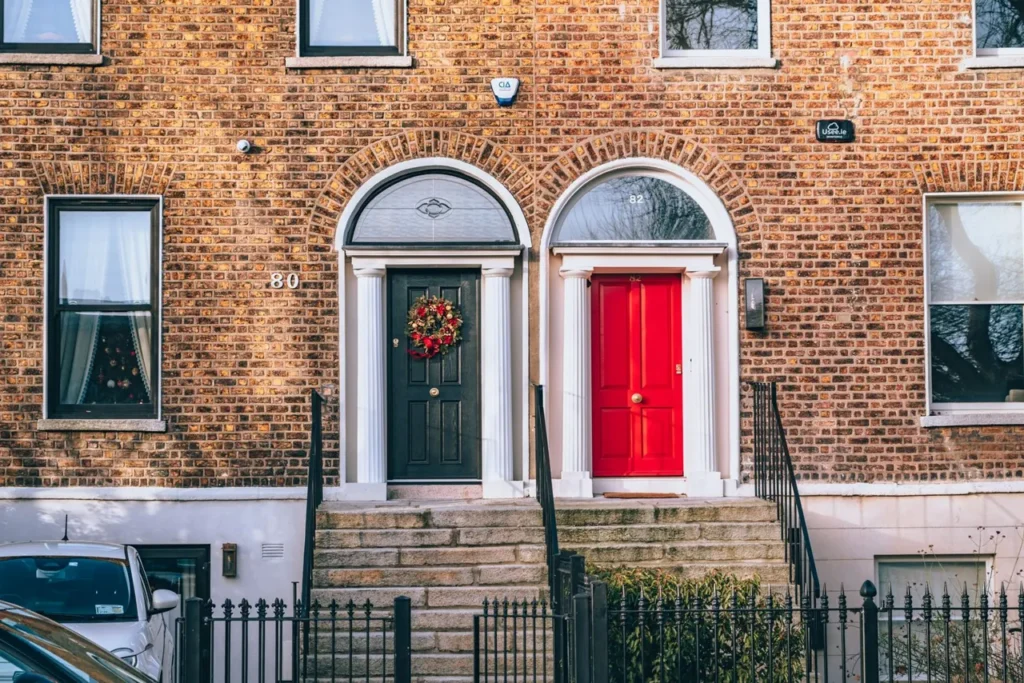
The often-repeated idea that a red door is always lucky comes from Chinese tradition, where red is auspicious. In element terms, red suits a south-facing door best.
If your door faces an “unfavourable” direction
This is the situation most people are in, and practitioners generally respond the same way:
- Work with the element. Use a door colour, a doormat or planters that suit the direction’s element or the one that feeds it.
- Focus on the condition of the door. A clean, freshly painted door, working lock and hinges, a clear house number and good lighting count for more than direction.
- Make the approach welcoming. A clear, gently curving path, healthy plants and no bins in front of the door.
- Add protection if it reassures you. A pair of guardian lions outside, or an evil eye charm hung inside facing the door, are traditional. My guide to where to hang an evil eye covers the placement.
- Use a favourable direction elsewhere. If you follow the Kua approach, use your favourable directions for your bed and desk, which are easier to change.
Beyond paint: mats, planters and light
If you rent, or you’d rather not repaint, the same element logic can be applied to smaller items at the door:
- Doormats. A mat in the colour of the direction’s element, or its supporting element, is an easy change. Rectangular mats carry earth; round ones metal; wavy patterns water.
- Planters. Pots are a flexible way to add elements: terracotta or stone for earth, metal for metal, glazed black or blue for water. A healthy plant adds wood to any door.
- Lighting. A good outdoor light adds fire, and practitioners often recommend one for doors facing north or northeast, which get little direct sun.
- Door hardware. Brass or metal handles and numbers bring metal, suiting west and northwest doors.
- House numbers. Clear, visible numbers help visitors, and opportunities, find you. Many practitioners say that’s the point.
When you mostly use a different door
Many households rarely use the front door, coming and going through the back door or the garage instead. Practitioners differ on how to treat this. Most classical teachers say the designed front door remains the main door for orientation purposes, because it’s the “mouth” the building was built around. Others say the door you use most becomes the effective main entrance for energy coming in. A practical compromise is to keep both in good order: use the designed front door for orientation and bagua mapping, but make sure the door you use daily is clean, lit and uncluttered too, since that’s where most of your arrivals and departures happen.
In blocks of flats, there are usually two doors to consider: the building entrance and your own front door. The building entrance affects everyone, and there’s usually little you can do about it beyond keeping your own route through the building pleasant. Your own door is the one to work with. Its direction can be measured from inside your flat in the same way, and the same colour and element ideas apply to whatever you’re allowed to change: a doormat, a small plant if the building permits it, or the inside face of the door.
Layout matters as much as direction
What the door faces inside the home is usually more important in day-to-day feng shui than which compass point it faces outside. A door that opens onto the stairs, a wall or straight through to the back door gets more attention from practitioners than a door facing northwest instead of southeast. I cover those situations in my guide to fixing awkward front door layouts, and you’ll find a range of practitioners’ views in my roundup of front door advice from practitioners.
House-hunting with door direction in mind
If you’re choosing a home and want to consider direction:
- Take a compass reading at the front door of each property you view.
- Check it against your household’s Kua directions if you use them.
- Look at what the door faces outside: a road pointing straight at the door, a sharp building corner or a lamp post directly in front are classic concerns in Form School feng shui.
- Look at what the door faces inside: stairs, a wall or a straight run through to the back.
- Weigh it against everything else that matters about a home. Direction is one factor among many.
Frequently asked questions
Which direction is best for a front door in feng shui?
There’s no single best direction. Popular guides often favour south, southeast or east, but classical practitioners judge it against the household’s Kua directions and other factors.
How do I find which way my front door faces?
Stand inside the doorway facing out and take a compass reading. That’s the facing direction.
Is a north-facing front door bad feng shui?
No. North is linked with water and career. It’s favourable for East group Kua numbers. Black, dark blue or metal colours are traditional choices.
What colour should my front door be?
Choose the colour of the facing direction’s element or the element that feeds it. For example, red or green for a south-facing door.
Is a red front door lucky?
Red is auspicious in Chinese culture. In element terms it suits south-facing doors best.
Does door direction matter in an apartment?
Most practitioners use your apartment door for your own home, though the building entrance matters for the building as a whole.