

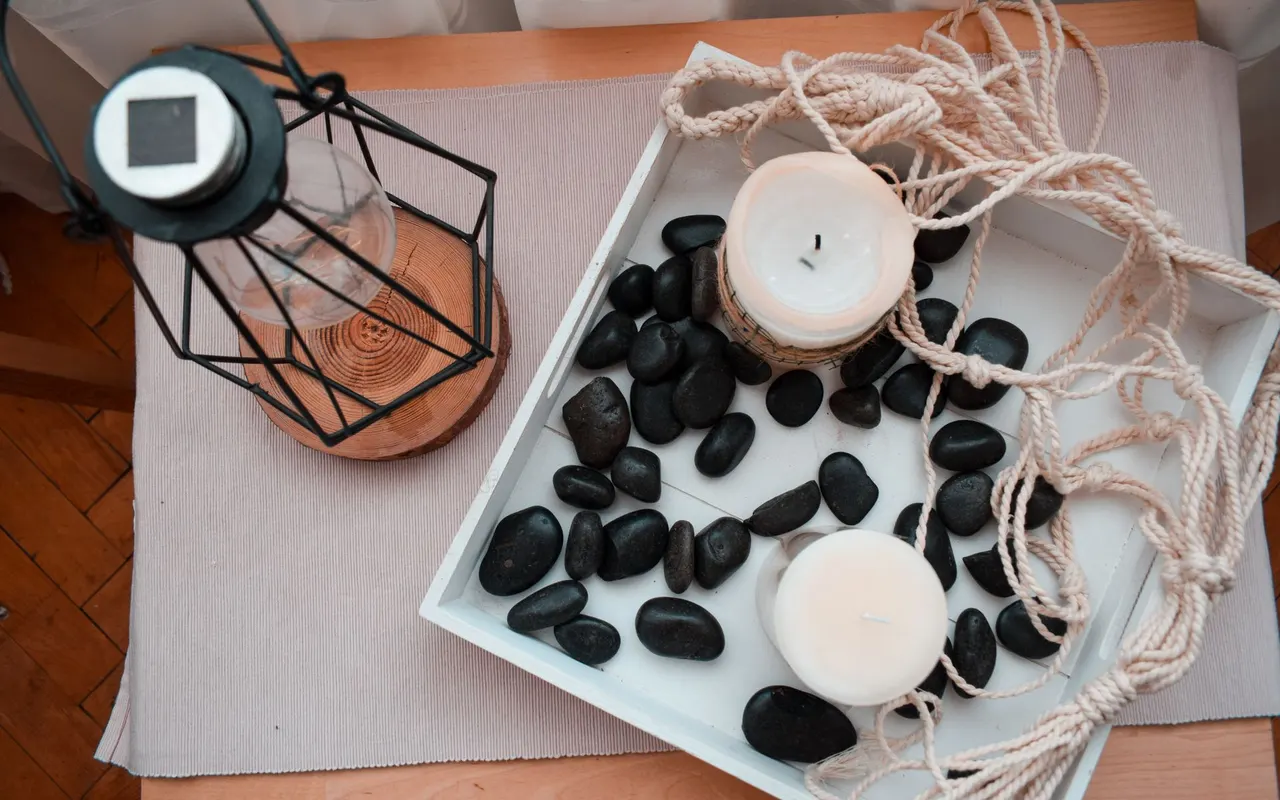
The five elements, wood, fire, earth, metal and water, are the vocabulary feng shui uses to describe what a room is made of and how it feels. When a practitioner suggests adding a plant to a corner, swapping a black rug for a terracotta one or putting a metal bowl on a shelf, they’re usually working with the elements.
This guide explains what each element looks like in a real home, how the elements relate to each other through the productive and controlling cycles, and how to use those cycles to balance a room. There are reference tables for colours, shapes and materials, a section on the elements in the bagua, and a few worked examples.
Key takeaways
- The five elements (wu xing) are wood, fire, earth, metal and water. “Phases” is a closer translation: they describe types of energy that change into one another.
- Each element is expressed through colours, shapes, materials and objects.
- In the productive cycle, each element feeds the next: water, wood, fire, earth, metal, and back to water.
- In the controlling cycle, each element checks another: water controls fire, fire controls metal, metal controls wood, wood controls earth, earth controls water.
- Balancing a room usually means adding a missing element or softening a dominant one, often by using the element in between.
What the five elements are
The Chinese term wu xing is often translated as “five elements”, but “five phases” or “five movements” is closer. The idea is less about substances and more about types of energy that grow, peak, decline and transform. Wood is the energy of growth and spring; fire of peak and summer; earth of stability and late summer; metal of contraction and autumn; water of stillness and winter.
The elements are one of the core principles of feng shui, alongside qi and yin and yang, which I’ve outlined in my guide to the basic principles of feng shui.
The elements at home
| Element | Qualities | Colours | Shapes | Materials and objects |
|---|---|---|---|---|
| Wood | Growth, vitality, flexibility | Green, teal | Tall, columnar, vertical stripes | Living plants, wooden furniture, cotton and linen, botanical prints |
| Fire | Passion, visibility, warmth | Red, orange, bright pink, purple | Triangles, points, zigzags | Candles, lamps, fireplaces, sunlight, animal prints |
| Earth | Stability, grounding, nourishment | Yellow, ochre, sand, terracotta | Square, flat, low, horizontal | Ceramics, stone, brick, clay pots, crystals |
| Metal | Clarity, precision, order | White, grey, silver, gold | Round, oval, arches | Metal frames and bowls, round mirrors, white stone |
| Water | Flow, reflection, depth | Black, deep blue | Wavy, irregular, free-form | Fountains, glass, mirrors, images of water |
Most objects carry more than one element. A green ceramic pot is wood by colour and earth by material. A round black mirror is metal by shape and water by colour and reflection. That’s normal; you’re looking at the overall feel of a room, not scoring each object.
The productive cycle
In the productive (or generating) cycle, each element nourishes the next:
- Water feeds wood: plants need water to grow.
- Wood feeds fire: wood is fuel.
- Fire creates earth: fire leaves ash.
- Earth produces metal: metals are found in the earth.
- Metal carries water: metal collects condensation, and metal vessels hold water.
Practitioners use this cycle to strengthen an element. If a room needs more wood, you can add wood directly (plants, wooden furniture) or add water, which feeds wood (a dark blue rug, a small water feature).
The controlling cycle
In the controlling (or destructive) cycle, each element checks another:
- Water controls fire: it puts it out.
- Fire controls metal: it melts it.
- Metal controls wood: it cuts it.
- Wood controls earth: roots break up soil.
- Earth controls water: it absorbs or dams it.
“Destructive” sounds negative, but control is necessary. A home with nothing to check fire would feel overheated and restless. Practitioners use this cycle to calm an element that’s too strong.
The reducing cycle: a gentler way to calm
There’s a third, less often mentioned relationship. Because each element feeds the next, adding the element that a dominant one feeds will gently drain it. Too much fire? Add earth, which fire “feeds”, to draw some fire energy away. This is often preferred to the controlling cycle because it’s softer: earth calms fire without the clash of putting water directly against it. For example, a room with a lot of red and bright light can be calmed with sand, ochre or terracotta tones and ceramic pieces, rather than a large black rug.
Balancing a room: a step-by-step approach
- Decide what the room is for. A bedroom needs calm; a home office needs focus; a living room needs warmth and sociability.
- Look at what dominates. Walk in and notice the main colours, materials and shapes. Is the room mostly white and metal? Mostly wood? All red?
- Look at what’s missing. Is there no living thing (wood)? No warm light (fire)? Nothing grounding (earth)?
- Adjust with the cycles. Add a missing element directly or through the one that feeds it. Calm a dominant element through the one it feeds or, more strongly, the one that controls it.
- Use small items first. Cushions, plants, a lamp, a bowl, a picture. Repainting can come later if you still feel it’s needed.
Worked examples
A cold, white, minimalist living room. White walls, grey sofa, chrome lamp: heavily metal. To warm it up, add fire (warm lamps, a candle, a red or orange accent) and earth (terracotta pots, a sand-coloured rug). Fire controls metal; earth is a gentler link. A couple of plants add wood and life.
A dark, cluttered study. Dark blue walls, black furniture, heavy curtains: a lot of water, and probably a lot of yin. Add earth to absorb some water (a yellow lamp, ceramics, a square rug), and wood to draw the water into growth (plants). Brighter lighting adds fire to lift the room.
A busy, bright red kitchen. Red units and lots of light: plenty of fire, which suits a kitchen up to a point. If it feels overheated, add earth (stone counters, ceramic jars, yellow accents) to calm it gently. A green herb pot brings wood without adding more fire than it already has.
A bedroom that feels restless. Bright colours and pointed shapes add fire and yang. Soften with earth tones, round shapes (metal) and calm, muted colours. My guide to yin and yang adds the other half of this picture.
The elements room by room
Each room has a natural elemental character, which is a useful starting point before you change anything:
- Kitchen: fire (the stove) and water (the sink) meet here. Wood, which sits between them in the productive cycle, is often added as a buffer: a wooden chopping board, herbs or green accents between the hob and the sink.
- Bathroom: water dominates. Wood (plants, green towels) uses the water constructively; a little earth (stone, ceramics) keeps it from feeling damp and draining.
- Bedroom: calm earth tones, soft wood greens and gentle metal whites suit rest. Strong fire is usually kept to accents.
- Living room: the most flexible room. A mix of all five elements, with wood and fire for warmth and sociability, tends to work well.
- Home office: metal brings focus and order; wood brings growth and creativity; a little fire (good light) keeps energy up. Too much water can feel sleepy.
- Entrance: often a good place for wood (a healthy plant) and fire (good light) to welcome energy in.
The elements through the seasons
Because the elements are phases of a cycle, they’re also linked with the seasons: wood with spring, fire with summer, earth with late summer, metal with autumn and water with winter. Some practitioners adjust their homes through the year to balance the season. In winter, a water season, they add warmth and fire with candles, warm lamps and red or orange textiles, and earth with heavier natural textures. In summer, a fire season, they lighten the home with cool colours, more water and metal, and fewer heavy fabrics. In spring, they emphasise fresh wood energy: plants, flowers, clearing out and opening windows. It’s an easy way to keep a home feeling fresh, whatever you think of the theory.
The elements in the bagua
Each area of the bagua map is linked with an element, so practitioners often use the elements to enhance specific areas:
| Bagua area | Element | Supporting element (feeds it) |
|---|---|---|
| Wealth (SE / far left) | Wood | Water |
| Family (E / middle left) | Wood | Water |
| Fame (S / far centre) | Fire | Wood |
| Relationships (SW / far right) | Earth | Fire |
| Centre | Earth | Fire |
| Knowledge (NE / front left) | Earth | Fire |
| Children (W / middle right) | Metal | Earth |
| Helpful people (NW / front right) | Metal | Earth |
| Career (N / front centre) | Water | Metal |
So a plant in the wealth area adds wood; a small water feature there adds the element that feeds wood. Metal objects in the wealth area are used sparingly, because metal controls wood. My step-by-step guide to using the bagua map explains how to find each area.
Your personal element
Many feng shui approaches also assign each person an element from their birth year. Some people use it to choose colours and materials for their own spaces, using their element and the one that feeds it. My guide to finding your feng shui element explains the birth-year method and the different systems, and there’s a companion guide on using your element at home.
Common mistakes with the elements
- Taking it too literally. You don’t need a fountain, a fireplace and a gold bowl in every room. Colours and shapes count.
- Fixing what isn’t broken. If a room feels good, you don’t need to balance its elements on paper.
- Ignoring the room’s purpose. A kitchen is supposed to have fire; a bathroom is supposed to have water.
- Overusing the controlling cycle. Placing a strong controlling element can make a room feel tense. The gentler reducing cycle is often better.
Frequently asked questions
What are the five elements in feng shui?
Wood, fire, earth, metal and water. Each represents a type of energy and is expressed through colours, shapes and materials.
How do the five elements interact?
Through the productive cycle, where each feeds the next, and the controlling cycle, where each checks another. A third, reducing, relationship gently drains an element by adding the one it feeds.
How do I balance the elements in a room?
Notice which element dominates and which is missing, then add the missing one or the element that feeds it, and calm the dominant one with the element it feeds.
Which element is a mirror?
Mirrors are usually associated with water because they reflect. A round metal-framed mirror also brings metal.
Which element are plants?
Living plants are the clearest expression of wood.
What element is good for a bedroom?
There’s no single answer. Soft earth tones, muted wood greens and gentle metal whites are common choices because they support a calm room.