

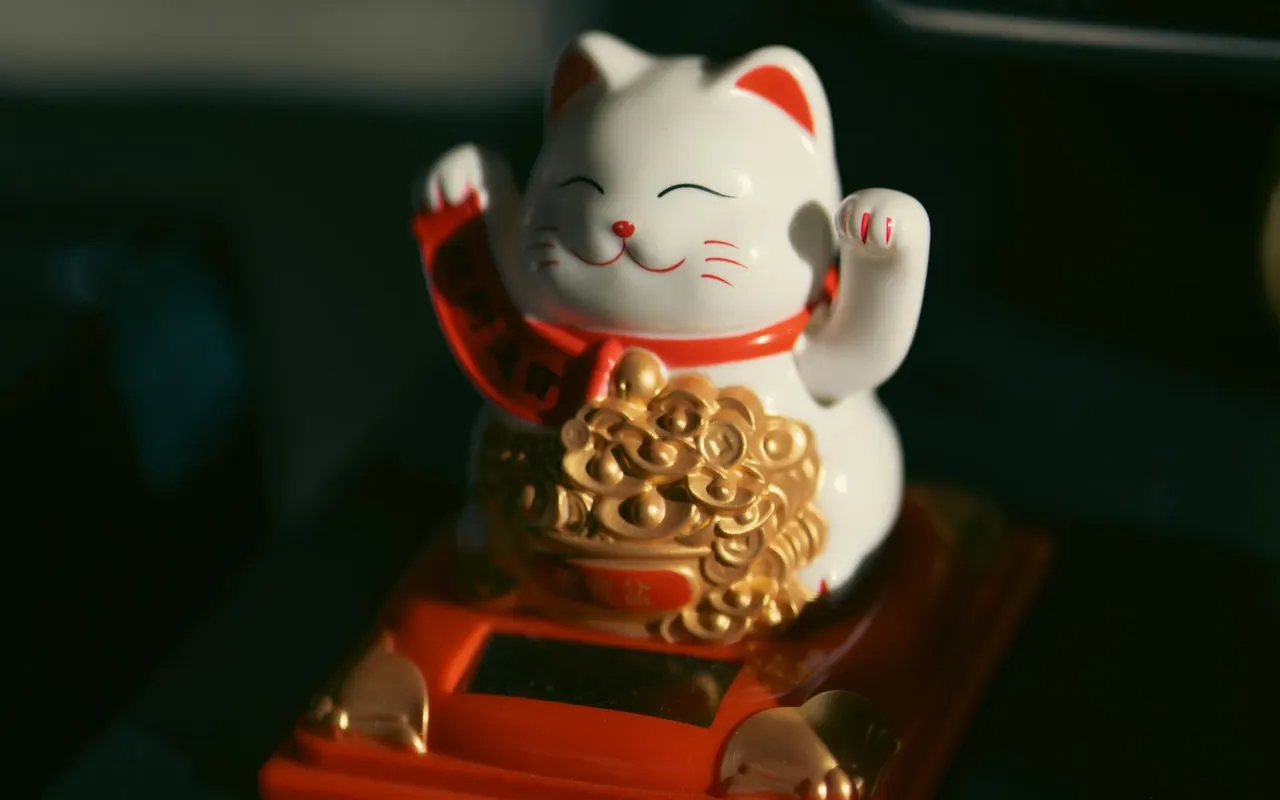
The waving lucky cat, or maneki-neko (“beckoning cat”), sits by the till in restaurants and shops around the world. It’s Japanese in origin, dating back to at least the Edo period, and was later taken up by Chinese businesses and by feng shui writers as a symbol of good fortune and welcoming customers. Today it’s one of the most popular lucky objects for the home.
Placement is simple once you know what each paw and colour is meant to say. Here’s a practical guide.
Key takeaways
- The classic spot is near the entrance, facing the front door, to “beckon” people and luck inside.
- A raised left paw is usually read as inviting people and customers; a raised right paw as inviting money and good fortune. Both paws up means both.
- Gold is for wealth, white for happiness, black for protection and red for warding off bad luck, though colour meanings vary between sellers.
- The wealth corner, a shop counter and a home office desk are other common spots.
- Keep it clean, in good repair, and out of bathrooms and cluttered corners.
Where the lucky cat comes from
Several Japanese folk stories explain the cat’s origin. The most often told is about a temple cat in Tokyo that beckoned a passing lord inside just before a storm. The lord became the temple’s patron, and the cat became a symbol of good fortune. Whatever the true origin, the beckoning gesture (palm out, fingers curled down, the way people in Japan wave someone over) is the heart of the symbol. Battery-powered cats that wave back and forth became popular much later.
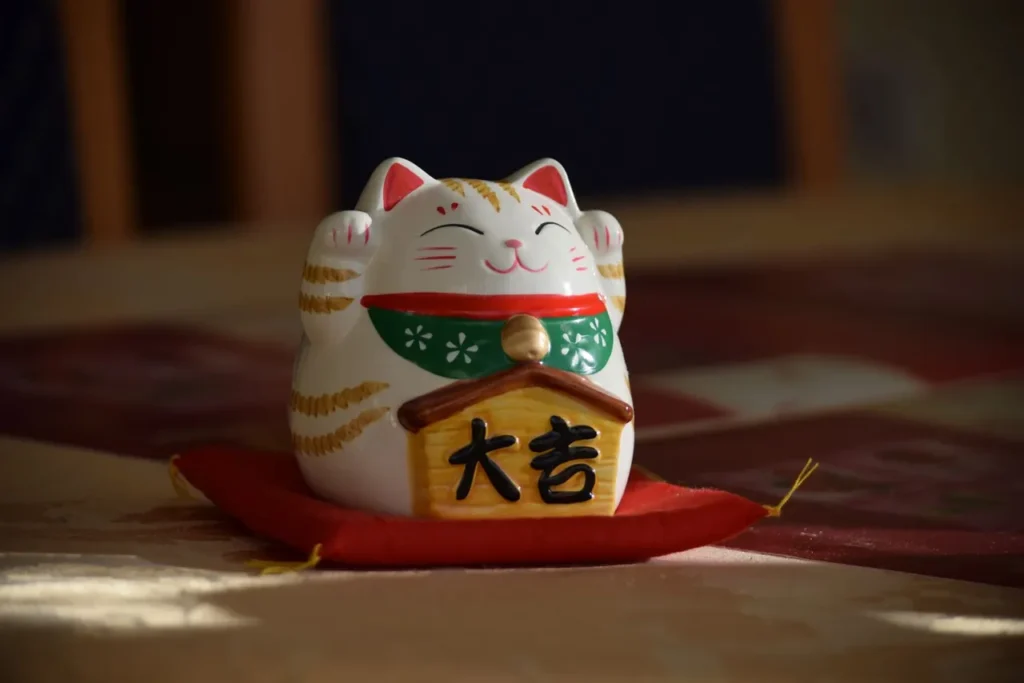
It isn’t a classical feng shui object. It’s a Japanese good-luck charm that feng shui shops and writers adopted, so placement advice blends Japanese meaning with feng shui ideas about doors and the bagua.
Left paw, right paw, or both?
| Raised paw | Usual meaning | Good for |
|---|---|---|
| Left | Inviting people: customers, guests, friends | Shops, restaurants, a sociable home |
| Right | Inviting money and good fortune | Home offices, the wealth corner |
| Both | Inviting both, or protection for the home | Entrances |
You’ll find these reversed in some sources, and the height of the paw is sometimes said to matter too (the higher, the further the luck travels). None of it is fixed. Choose the version whose meaning you like.
What the colours mean
- Gold: wealth and prosperity, the most common choice for businesses.
- White: happiness, purity and positive things to come; the traditional default.
- Black: protection, warding off ill intentions.
- Red: protection from bad luck and illness.
- Green: health, and in some lists good results in study.
- Pink: love and relationships.
Colour meanings have grown over time and many were added by modern sellers, so treat them as suggestions rather than rules.
The best places for a lucky cat
Near the entrance, facing the door
This is the classic placement and the one with the clearest logic: the cat beckons whoever comes through the door. Put it on a shelf, console or windowsill near the entrance, facing in toward the door rather than away from it. A slightly raised spot, at or below eye level, is typical.
In the wealth corner
A gold cat with the right paw raised is often placed in the wealth area of the home or living room. That’s the far left corner from the door in the Western bagua, or the southeast in the compass method. My guide to finding your wealth corner explains both, and the bagua corner finder will show you where it falls.
On a desk or shop counter
Businesses usually put the cat by the till or reception desk, facing the entrance. At home, a small cat on a home office desk serves the same purpose. Place it where you can see it, and where it faces the room’s door if possible.
In the living room
If the entrance has no room for it, the living room is the next best place. It should be visible from the room’s entrance, not tucked behind other objects.
Lucky cats with other symbols
The lucky cat is often placed alongside other wealth and protection symbols, especially near the entrance. It works best when each object has its own spot rather than all of them sharing one shelf. A common arrangement is guardian lions outside the door, an evil eye inside facing the door, and the lucky cat on a console or shelf nearby, also facing the door. The money toad, another wealth symbol, faces into the room as if it has just hopped in. If you’re juggling several objects, my placement table for 15 common feng shui symbols shows where each traditionally goes.
Lucky cats in shops and small businesses
The maneki-neko is above all a business charm. Its raised paw is a beckoning gesture, inviting customers in, which is why you’ll find it by the till of so many restaurants and shops across Asia and beyond. If you run a business:
- Place the cat near the entrance or the till, facing the door, so customers see it as they arrive.
- A cat with the left paw raised is traditionally said to beckon customers; the right paw, money. Many businesses choose the left, or a cat with both paws raised.
- Keep it clean and well lit. A dusty cat in a dark corner isn’t much of a welcome.
- For online businesses and home offices, the desk where you work is the natural equivalent of the till.
Choosing a lucky cat
A few practical points help when you’re buying one:
- Material. Ceramic and porcelain are traditional. Plastic battery-powered waving cats are a modern variation and are fine if you like them.
- Size. Choose a size that fits the spot without crowding it. A small cat on a desk, a medium one on a console.
- Details. Many cats hold a koban, an old Japanese gold coin, inscribed with wishes for prosperity. Some wear a bib and bell, a reference to the collars of pet cats in the Edo period.
- Condition. Check for chips and cracks; a damaged cat is traditionally replaced rather than displayed.
A lucky cat as a gift
A maneki-neko is a popular gift for a new business, a shop opening or a new home. Choose the colour and paw to suit the recipient: a white cat with the left paw raised for a shop, a gold cat with the right paw raised for wealth, a pink cat for love. A short card explaining where it’s traditionally placed helps it end up in the right spot rather than on a high shelf.
Where to avoid putting one
- Bathrooms. Feng shui treats them as places where energy and luck drain away.
- Facing out of the front door, which is read as beckoning luck away.
- Cluttered shelves or the floor. Lucky objects are meant to be given a little space.
- Next to the bin or anywhere it gets knocked about.
Looking after your lucky cat
Dust it regularly and replace batteries in waving models promptly; a cat that has stopped waving isn’t “broken luck”, but it’s an easy way to keep the object cared for. If a cat chips or cracks, many people retire it and get a new one, in the same way people replace a cracked evil eye charm, a custom explained in my guide on where to hang an evil eye.
Frequently asked questions
Which way should a lucky cat face?
Toward the front door or the main entrance of the room, as if welcoming whoever comes in.
Is the lucky cat Chinese or Japanese?
Japanese. It’s widely used in Chinese businesses and in feng shui, which is why it’s often assumed to be Chinese.
Can I have more than one lucky cat?
Yes. Some shops display many. At home, one cat near the entrance and one in the wealth corner or office is a common combination.
Does a lucky cat have to wave?
No. The traditional figures are still ceramic; the waving, battery-powered kind is a modern variation.