

A mirror is one of the most debated objects in bedroom feng shui. The traditional view is that mirrors bounce and multiply energy, which is useful in a hallway or a dark corner but unsettling in a room meant for rest. In practice, most of the advice comes down to one rule: don’t let a mirror face the bed. Everything else is about where a mirror can still work for you.
Below you’ll find the main dos and don’ts, quick fixes if you can’t move a wardrobe mirror, and what tradition says about shape and size. As with all feng shui advice, treat it as a traditional guideline for a calmer room, not a guarantee of better sleep.
Key takeaways
- Keep mirrors out of the line of sight from the bed, both lying down and sitting up.
- Side walls, the inside of a wardrobe door and the space beside a window are the usual “safe” spots.
- Avoid mirrors above the bed, on the ceiling, or reflecting the bedroom door.
- If a mirror has to face the bed, cover it at night with a curtain, a throw or a closed door.
- One well-placed mirror is enough for most bedrooms.
Why mirror placement matters in feng shui
In feng shui, mirrors are treated as “active” objects. They are believed to reflect and amplify chi, the energy that the practice says moves through a home. That’s why mirrors are popular for brightening a narrow hall or “pulling” light into a dim room.
A bedroom is the opposite of an active space. The aim is a still, settled feeling, so a mirror that catches movement, light from the window or your own reflection when you wake at night works against that. There is also a plain practical side: a mirror opposite the bed can reflect streetlight or a phone screen straight back at you.
The same logic runs through mirror advice for the rest of the home: what matters is what the mirror faces. If you’re weighing up a mirror in the hall or kitchen as well, I’ve set out the traditional view on each situation in my guide to mirrors facing the bed, door or stove.
Dos: the best places for a bedroom mirror
If you want a mirror in the bedroom, these positions are the ones most feng shui guides consider comfortable:

| Do | Why it works |
|---|---|
| Hang it on a side wall, not opposite the bed | You can use it while dressing without seeing it from the bed. |
| Use the inside of a wardrobe door | The mirror is only “on” when the door is open. |
| Place it near, but not facing, a window | It spreads daylight without bouncing it toward your pillow. |
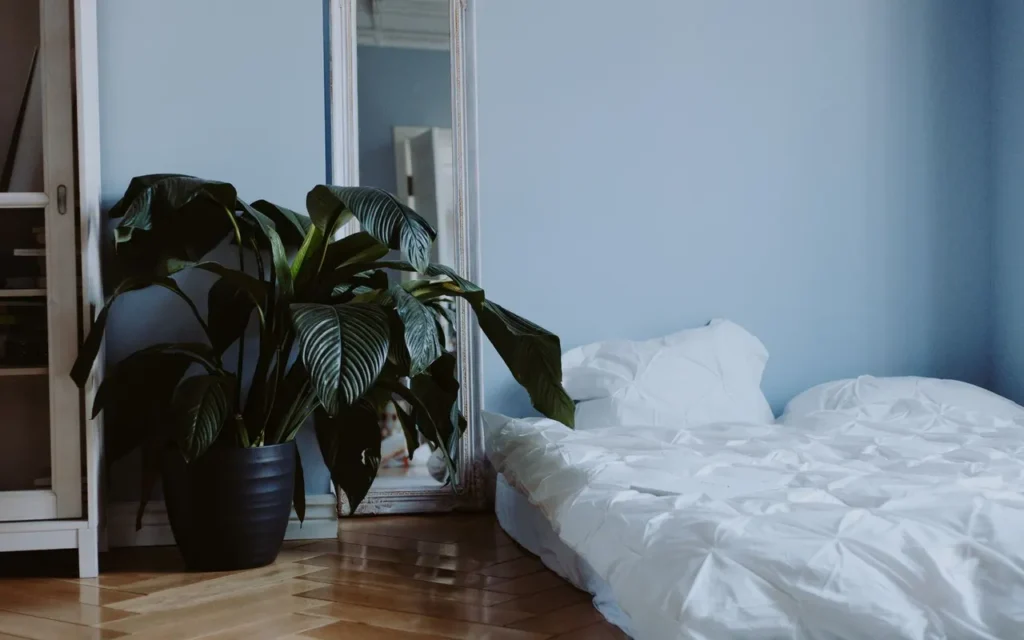
| Let it reflect something calm | A plant, artwork or an empty wall rather than clutter or the door. |
| Hang it at a height that shows your whole face | Tradition says a mirror shouldn’t “cut off” the top of your head. |
Don’ts: mirror placement mistakes to avoid
- A mirror facing the bed. This is the most common warning in bedroom feng shui. The belief is that it keeps energy moving around you while you sleep and can disturb rest.
- A mirror above the headboard or on the ceiling. Tradition sees these as unsettling, and many people simply find them uncomfortable to lie under.
- A mirror reflecting the bedroom door. The idea is that it pushes incoming energy straight back out. If you have a mirrored wardrobe opposite the door, keep it closed or partly covered.
- Several mirrors in one room. Multiple reflections make a room feel busy, which is the opposite of what most people want from a bedroom.
- A mirror reflecting clutter. Whatever a mirror shows is doubled. Clear what it faces, or move it.
What if you can’t move the mirror?
Rented flats and built-in wardrobes don’t always give you a choice. Feng shui has simple workarounds:
- Hang a light curtain or fabric panel over the mirror and close it at night.
- Drape a throw over a freestanding mirror before bed, or turn it toward the wall.
- Angle a standing mirror so it reflects a side wall instead of the bed.
- Keep mirrored wardrobe doors closed and, if you like, add a frosted film to part of the glass.
Mirrored wardrobes, en-suite doors and dressing tables
Most bedroom mirror problems in real homes come from fixtures rather than a mirror someone chose to hang. Three come up again and again.
Mirrored sliding wardrobes. These are common in flats and new builds, and they often run the full length of the wall opposite or beside the bed. If they reflect the bed, the simplest fix is a ceiling-mounted curtain track in front of them, which also softens the room. Frosted or decorative window film applied to the panels is a renter-friendly alternative that peels off cleanly. Sliding the doors so the mirrored panel sits behind a solid one at night also works if your wardrobe has mixed panels.
A mirror on the en-suite door. A mirror on the outside of a bathroom door that faces the bed carries two traditional concerns at once: the reflection, and the bathroom’s association with water draining away. Moving the mirror to the inside of the door solves both.
Dressing tables and vanities. A dressing table mirror is often the one that ends up reflecting the bed, simply because the table sits against the wall opposite. Turning the table to a side wall, or choosing a vanity with a mirror that folds or tilts down, keeps the use without the reflection. A small hand mirror kept in a drawer is the low-tech answer.
The one exception: a mirror that lets you see the door
There is one situation where many practitioners recommend a mirror in the bedroom. If the room’s shape forces your bed into a spot where you can’t see the door while lying down, a small mirror placed so that the doorway is visible from the pillow is a traditional fix for the missing “command position”. The important detail is that the mirror shows the door, not the bed. The reasoning behind the command position, and what to do when the bed can’t take it, is covered in my guide to where the head of your bed should go.
Mirrors in a small bedroom
In a small room it’s tempting to use a large mirror to make the space feel bigger, and that’s a reasonable instinct. The way to do it without breaking the main rule is to hang the mirror on the wall beside the bed, or on the wall the bed’s side faces, so that it reflects the window or the open floor rather than you. A tall, narrow mirror on a side wall often does more for a small room than a wide one. My small bedroom feng shui plan works through layouts where there’s only one sensible spot for the bed.
A quick mirror check before bed
If you want a simple test, lie down as you would to sleep and look around. Can you see yourself or the bed in any reflective surface, including a TV screen or a glass picture frame? If so, that’s the one to move, angle or cover. Then sit up as you would in the morning and repeat. Most people find one surface they hadn’t thought of. The bedroom feng shui checklist includes this check alongside bed position, storage and light.
Mirror shapes and sizes
Shape matters less than position, but tradition does link each shape to an element and a mood:
- Round and oval mirrors are associated with the metal element and with softness and completeness. They suit a calm bedroom well.
- Square and rectangular mirrors are linked to stability and the earth element and fit modern rooms.
- Full-length mirrors are practical for dressing. Keep them to one side of the bed or inside a wardrobe.
Choose a size that fits the wall comfortably. A mirror that dominates the room draws attention, and in a bedroom you usually want the opposite.
Frequently asked questions
Can I place a mirror directly facing the bed?
You can, but it’s the placement feng shui advises against most consistently. If there’s no other option, cover the mirror at night or keep the wardrobe door closed.
Should I avoid mirrors on the ceiling or above the bed?
Yes. Traditional feng shui considers both unsettling for sleep. A side wall or the inside of a wardrobe door is a better choice.
Can I hang a mirror on the bedroom door?
On the inside of the door it’s generally fine as long as it can’t be seen from the bed. Avoid a mirror that faces the door from across the room.
Is it OK to have more than one mirror in the bedroom?
One is usually enough. If you have more, make sure none of them reflects the bed and that they don’t face each other.
Is a TV in the bedroom the same as a mirror?
Many practitioners treat a large, dark screen like a mirror because it reflects the bed when it’s switched off. A cabinet with doors, or a throw over the screen at night, is the usual fix.
Does the shape of the mirror matter?
Position matters far more than shape. Round mirrors are often recommended for bedrooms because they feel softer, but any shape is fine if it’s placed well.