

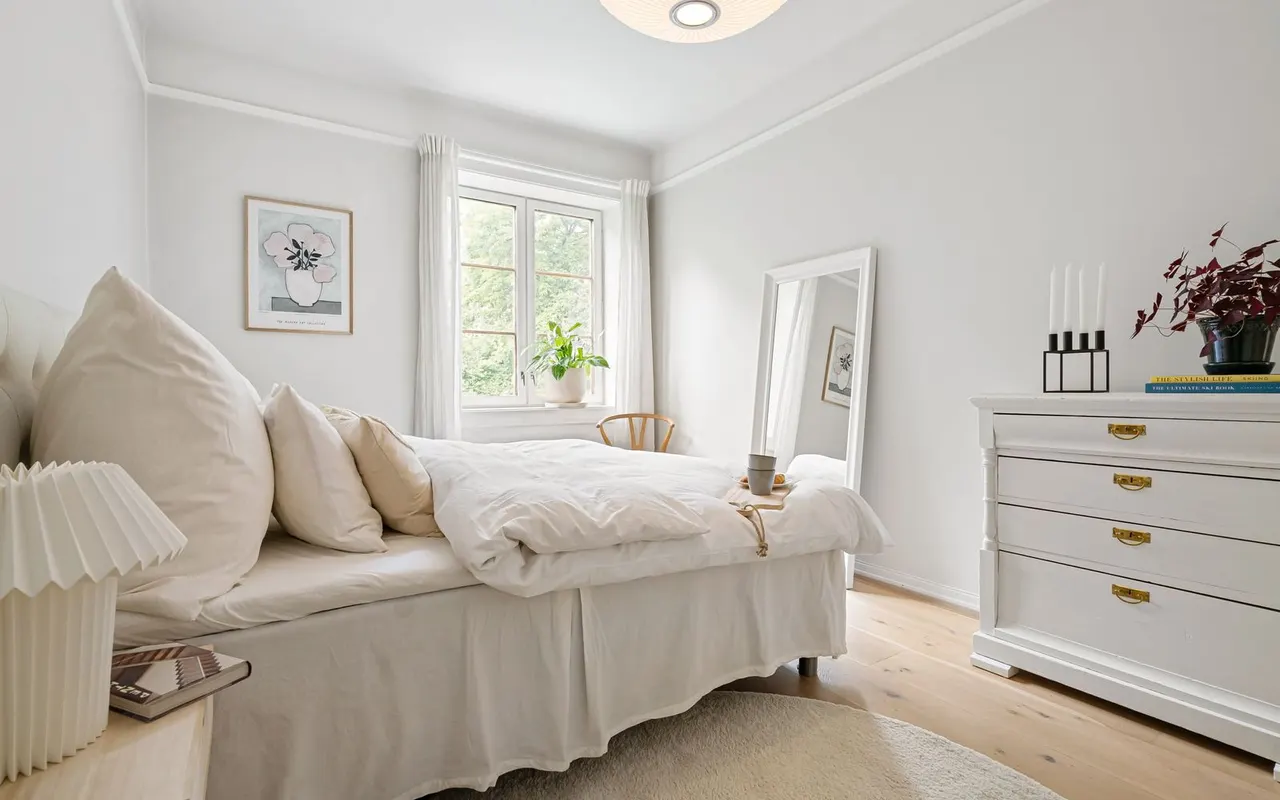
If you only change one thing in your bedroom, most feng shui teachers would point you to the bed. It’s the largest piece of furniture in the room, you spend hours a night in it, and almost every school of feng shui has an opinion on where its head should go.
The short version: put the head of the bed against a solid wall, in a spot where you can see the bedroom door without lying directly in line with it. Direction (north, east and so on) comes second, and it’s where the different schools disagree. This guide walks through the layout rules first, then the compass question, then what to do when your room doesn’t cooperate.
Key takeaways
- The “command position” matters more than compass direction: see the door from the bed, but don’t line your feet up with it.
- A solid wall behind the headboard is the most consistent piece of advice across schools.
- Try to avoid placing the head of the bed under a window, under a heavy beam, or against a wall shared with a toilet or stove.
- Compass direction is optional. If you want to use it, the Eight Mansions method matches it to your personal Kua number.
- When the room won’t allow the ideal spot, a solid headboard, heavy curtains or a small mirror placed so you can see the door are the usual fixes.
Start with the command position
Feng shui calls the ideal spot for a bed, desk or stove the command position. For a bed it means three things:
- You can see the door while lying in bed, without twisting your head.
- You are not directly in line with the door. A bed whose foot points straight out of the doorway is traditionally called the “coffin position”, because in old Chinese custom the dead were carried out feet first. Even if you don’t find the symbolism persuasive, a bed in the direct path of the door tends to catch drafts, hallway light and noise.
- The head of the bed is against a wall, ideally the wall diagonally across the room from the door.
The reasoning is partly symbolic and partly very ordinary. Tradition says a person who can see who’s coming rests more deeply. In everyday terms, people tend to feel more settled when nothing can approach from behind or out of sight. You don’t have to accept the theory of chi to see why the layout feels calmer.
In a small or awkwardly shaped room, these three points can pull against each other. I’ve written a separate small bedroom feng shui plan that ranks them for rooms where the bed only fits one way.
What should be behind the headboard
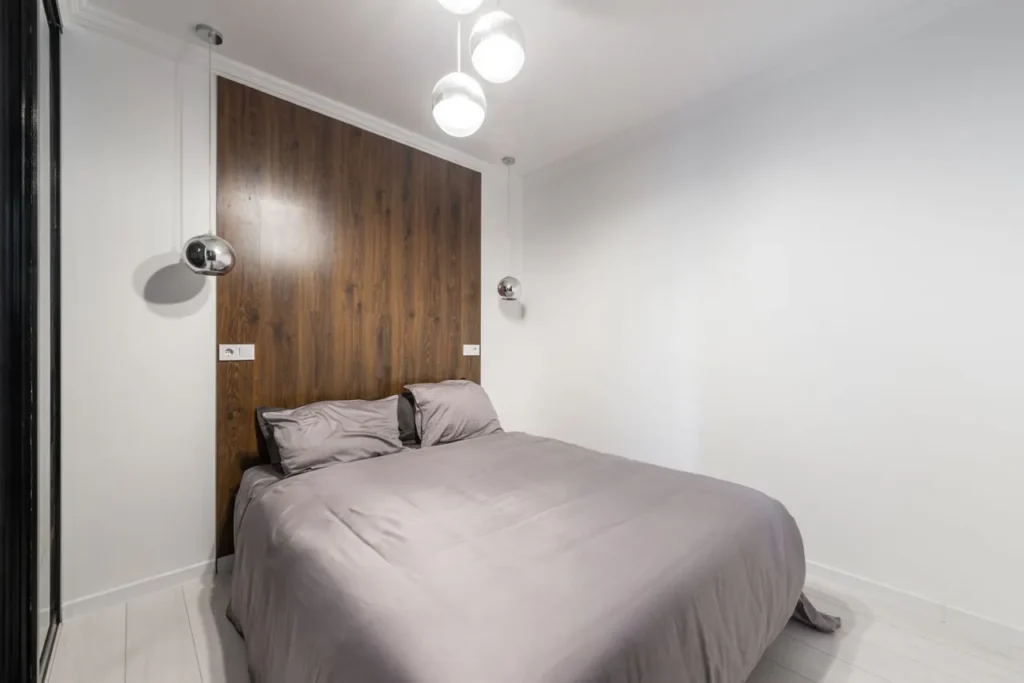
Almost every feng shui source agrees on this one: the head of the bed should rest against a solid wall. The wall is described as “support”, the same idea as having a mountain at your back in classical landscape feng shui.
| Behind the headboard | Traditional view | Practical note |
|---|---|---|
| Solid wall | Ideal: steady, supportive | Quieter and less drafty |
| Window | Avoid if you can: energy “leaks” out behind you | Drafts, light at dawn, noise from outside |
| Wall shared with a toilet | Avoid: water draining away behind your head | Plumbing noise at night |
| Wall shared with a stove or fireplace | Avoid: fire energy too active for rest | Heat and kitchen sounds |
| Floating in the middle of the room | Unsupported, unsettled | Fine in a large room only with a solid headboard |
A solid headboard (wood or upholstered, without bars or gaps) is the standard way to add support where the wall isn’t ideal. My guide to headboards to avoid covers which shapes and materials tradition prefers.
What should be above the bed
Feng shui also looks up. Exposed beams, a sloping ceiling that dips over the pillows, heavy shelves or a large framed picture hung directly above your head are all considered “pressing down” on the sleeper. The simplest fix is to shift the bed so your head is clear of the beam or shelf. If that isn’t possible, many people soften a beam with fabric or paint it the same colour as the ceiling so it recedes.
Does compass direction matter?
This is where schools differ, so it helps to be clear about which tradition you’re following.
The Eight Mansions (Kua) method
In the Eight Mansions school, each person has a Kua number based on their birth year, and that number gives four favourable and four unfavourable directions. The advice is to point the top of your head while sleeping toward one of your favourable directions. People in the East group (Kua 1, 3, 4 and 9) are generally pointed toward north, south, east and southeast; people in the West group (Kua 2, 6, 7 and 8) toward west, northwest, southwest and northeast.
You can work out your number with the free Kua number calculator, which lists your four directions with their traditional names.
General directional associations
Many popular guides also attach a general meaning to each direction regardless of Kua: east for growth and new starts, south for recognition, west for creativity and children, north for stillness and deep rest. These associations come from the bagua and the five elements, and they vary from writer to writer. Treat them as optional.
When the two approaches conflict
If your favourable direction would put you under a window or in line with the door, most practitioners would tell you to keep the command position and a solid wall, then use direction as a tiebreaker only. A partner with a different Kua group is a common example: couples usually choose the layout that works for the room and accept that one person’s direction won’t be ideal. My guide on which direction your bed should face goes deeper into each direction.
When your room won’t allow the ideal spot
Small bedrooms, rentals and rooms with a door, a window and a radiator on three walls rarely allow textbook placement. These are the standard workarounds:
- Can’t see the door from bed? Place a small mirror so the doorway is visible from the pillow, as long as the mirror doesn’t face the bed itself. My bedroom mirror guide explains where a mirror can and can’t go.
- Bed has to sit under a window? Use a tall, solid headboard and heavy curtains or blinds that close fully at night.
- Bed is in line with the door? Put a bench, chest or rug at the foot of the bed to create a “buffer”, and keep the door closed while you sleep.
- Only one wall is free? Prioritise the solid wall behind your head over everything else.
- Sharing a wall with the bathroom? Keep the bathroom door closed and the toilet lid down, the two simplest traditional remedies.
Small details that support the layout
Once the bed is in place, a few finishing touches are traditionally recommended: matching nightstands or lamps on both sides for balance, nothing stored under the bed (or only soft bedding), and enough space to walk around both sides. My printable bedroom feng shui checklist pulls these into one page.
Frequently asked questions
Is it bad to sleep with your head toward the door?
Most feng shui sources advise against having either your head or your feet pointing straight at the door. Your head on the same wall as the door is less of a concern than lying directly in its path, but the ideal is a wall diagonally opposite the door.
Which direction should the head of the bed face for good sleep?
There’s no single answer in feng shui. The Eight Mansions school uses your Kua number; general guides often suggest north or east for rest. Layout comes first: a solid wall and a view of the door are more consistently recommended than any compass point.
Can the head of the bed go against a window?
It’s traditionally discouraged. If it’s your only option, a solid headboard and curtains that close fully are the usual compromise.
What if my partner and I have different favourable directions?
Choose the layout that gives you both a solid wall and a view of the door. Direction can then be used as a secondary preference, or you can follow the direction of whichever person is having more trouble sleeping.