

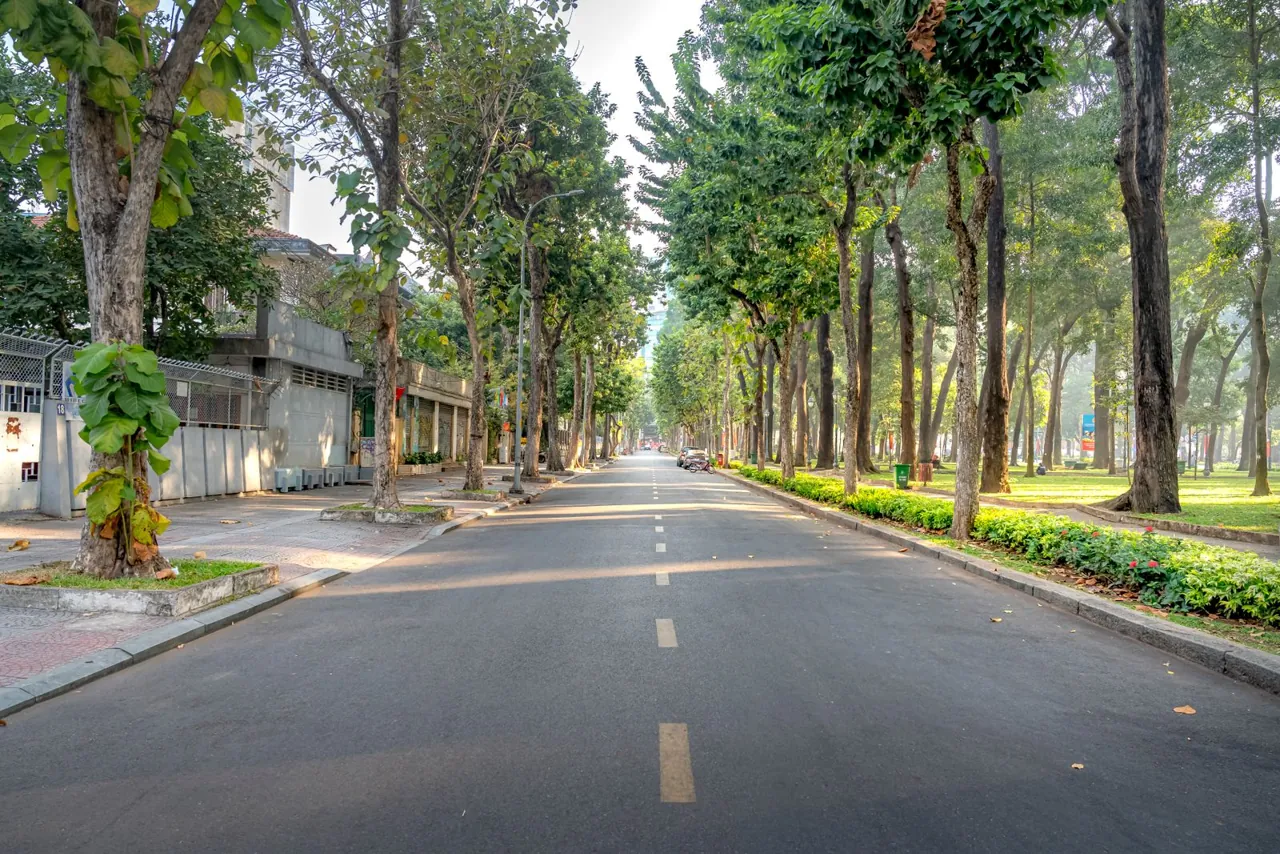
Feng shui started outdoors. Long before it was applied to sofas and bedrooms, it was used to choose sites for tombs, villages and cities, reading hills, rivers and roads. So yes, the same principles can be applied beyond your front door: to streets, parks, neighbourhoods and the town you live in. Here’s how that works, and how to use it when you’re choosing where to live.
Key takeaways
- Classical feng shui was first a landscape practice, applied to settlements and cities as well as homes.
- The ideal site has support behind (hills or taller buildings), open space in front and gently curving water or roads.
- Fast, straight roads aimed at a building, and sharp corners pointing at it, are traditionally avoided.
- Public spaces with good feng shui tend to feel sheltered, legible and welcoming, which overlaps with good urban design.
- When house-hunting, look at the street and surroundings as well as the floor plan.
Feng shui at the scale of a city
The classic model is the “armchair” landscape: a mountain behind for support (the black tortoise), lower hills on either side (the green dragon and white tiger) and open land with water in front (the red phoenix). Many historic Chinese cities were planned with this in mind. Beijing’s imperial centre runs on a north–south axis with protective high ground to the north; Seoul and Hong Kong are other places where feng shui has long shaped building decisions.
The four celestial animals in a neighbourhood
| Animal | Position (facing out from the home) | What you’d look for in a town |
|---|---|---|
| Black tortoise | Behind | A hill, taller buildings or mature trees at the back |
| Green dragon | Left | Slightly higher buildings or trees on the left side |
| White tiger | Right | Slightly lower buildings on the right side |
| Red phoenix | In front | Open space, a park or a gentle view |
Roads and water
In feng shui, roads behave like rivers: they carry energy. Gently curving roads that “embrace” a property are considered favourable. Roads that run straight at a building, as at a T-junction, are traditionally seen as sending too much energy at it, and a building on the outside of a sharp bend is said to be “cut” by the road. Many people would independently notice the same things as noise, headlights and traffic risk. If your own front door looks straight down a road or path, my guide to front door direction covers how the door is assessed.
Water, whether a river, lake or fountain in a square, is associated with wealth and calm, provided it’s clean and moving slowly rather than stagnant or rushing.
Sharp corners, flyovers and “poison arrows”
Feng shui calls harsh, cutting energy sha qi, and one of its classic sources is a sharp angle pointing at a building: the corner of a neighbouring block, a pylon, a lamp post directly in front of the door, or a flyover that slices past at window height. These are sometimes called “poison arrows”.
Traditional remedies try to soften or block the line rather than fight it. At street level that might mean a hedge, trees or tall planters between the door and the corner. Inside, it can mean curtains, frosted film or a plant in the window that faces the angle. Some practitioners also hang a small convex or bagua mirror outside, though in shared buildings that’s best discussed with neighbours first, since a mirror aimed at someone else’s home can cause offence.
Flats and high-rise living
Most city dwellers live in flats, so the “armchair” model has to be read at a different scale:
- Support behind: taller buildings behind your block can play the role of the tortoise. A block standing alone with nothing behind it is sometimes considered more exposed.
- The view in front: look out of the main windows. Open space, a park or water is valued; a blank wall a few metres away, or the sharp corner of another building, is less welcome.
- The corridor: notice whether your front door sits at the end of a long straight corridor or directly opposite a lift or stairwell. Both are said to send a rush of energy at the door; in practical terms they’re also noisier.
- Floor level: practitioners differ on which floors are best, often linking floor numbers to elements. It’s a minor factor compared with light, view and layout.
Public spaces that feel right
The qualities feng shui values in a public square or park overlap closely with what urban designers aim for:
- Shelter: a sense of enclosure on at least one side, so a space doesn’t feel exposed.
- Clear entrances: it’s obvious how to get in and where to go.
- Balance: sunny and shaded spots, busy and quiet zones (yang and yin).
- Nature: trees, planting and water.
- Care: clean, maintained spaces with no neglected corners.
Using this when you choose a home
- Walk the street at different times of day. Notice traffic speed and noise.
- Look behind the property: is there something solid, or an open drop?
- Check what faces the front door: a pleasant view, or the corner of a building pointing at you?
- Note nearby parks and water.
- Then look at the floor plan and the direction the front door faces.
None of this guarantees anything, but it’s a useful checklist that combines tradition with common sense. For the inside of the home, start with the entryway and the bagua map.
Frequently asked questions
Is it bad feng shui to live at a T-junction?
It’s traditionally seen as a challenging position, because the road points straight at the building. Common responses are a hedge, a wall or planting in front of the house, and a front door that’s not directly in line with the road where that’s possible. Noise and headlights are practical reasons people make similar changes.
Does living near water count as good feng shui?
Clean, slow-moving water in front of a home is considered favourable. Fast, polluted or stagnant water, or water directly behind a building, is viewed less positively.
Can I apply feng shui to a city I’m moving to?
Yes, at the level of choosing a neighbourhood and a street. Walk around at different times, notice how roads, parks and buildings sit around the homes you’re considering, and use the checklist above.