


Feng shui (pronounced roughly “fung shway”) translates as “wind and water”. It’s a Chinese practice for arranging buildings, rooms and objects so that a space feels supportive to the people who use it. Underneath the long lists of rules you’ll find online sits a fairly small set of ideas, and once you understand them, most feng shui advice starts to make sense on its own.
This guide explains those core principles in plain English: where feng shui comes from, what qi means, yin and yang, the five elements, the bagua map, the command position and the importance of clearing clutter. For each, I’ll explain what the idea is, how it shows up in a real home, and where you can go next for more detail. I’ll also be clear about where schools of feng shui disagree, because they often do.
Key takeaways
- Feng shui is a traditional Chinese practice concerned with how the arrangement of a space affects the people in it.
- Almost all feng shui advice rests on a few ideas: qi (energy) and how it flows, yin and yang, the five elements, the bagua map and the command position.
- There are several schools. The two you’ll meet most are classical (compass-based) and Western or BTB (front-door-based) feng shui.
- Clearing clutter and keeping a home well maintained are the foundations every school agrees on.
- Feng shui is a traditional practice, not a science. Many of its recommendations also have practical, everyday benefits.
Where feng shui comes from
Feng shui grew out of ancient Chinese practices for choosing good sites for homes, settlements and graves. Early practitioners looked at landforms, mountains, rivers and wind to judge whether a place would be sheltered, fertile and safe. The phrase “wind and water” reflects that: a good site was protected from harsh wind and close to gentle water.
Over many centuries, two broad approaches developed. Form School focuses on the shape of the land and the building: what’s behind, in front of and to each side. Compass School uses a specialised compass, the luopan, and calculations based on directions and time. Most classical practitioners today combine the two.
In the late twentieth century, a simplified Western approach developed, often called BTB (Black Sect Tantric Buddhist) feng shui, associated with Professor Thomas Lin Yun. It orients the bagua map to the front door rather than to the compass, which makes it easier to apply in apartments. Much of the popular feng shui advice in English uses this approach, often without saying so. Knowing which school a piece of advice comes from explains many of the apparent contradictions you’ll see.
Principle 1: qi, the energy of a space
At the centre of feng shui is qi (also written chi), often translated as energy or life force. In feng shui terms, qi moves through a home much like air or water: it enters through the front door and windows, flows through rooms and leaves again. The aim is for it to move gently and reach every part of the home, rather than rushing in a straight line or stagnating in a corner.
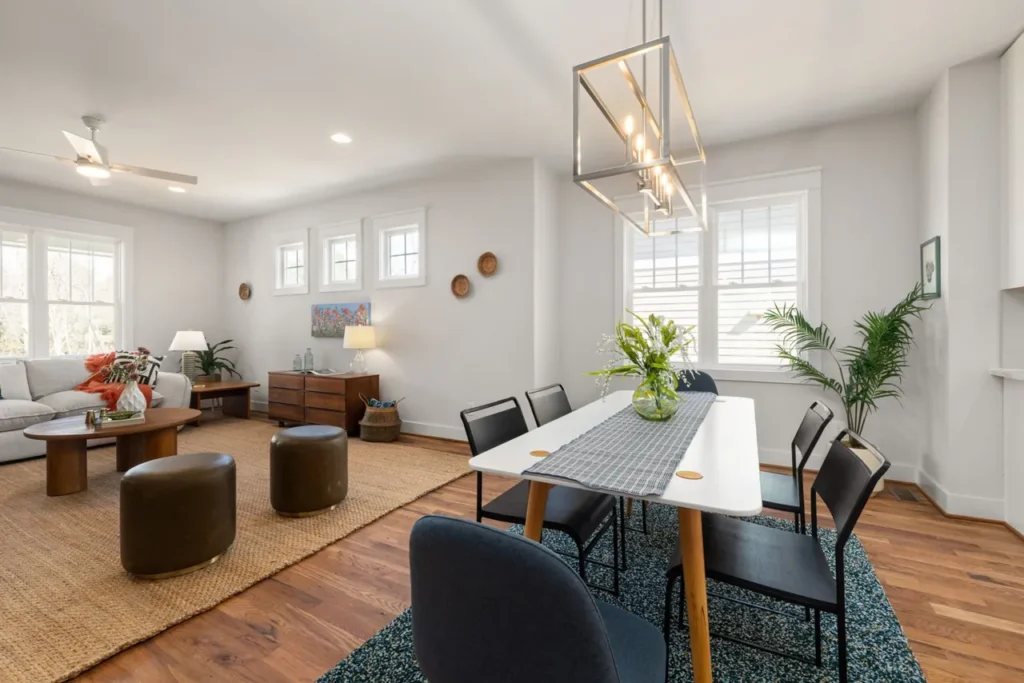
In practice this shows up as advice about flow: keeping the entrance clear, avoiding long straight corridors that “speed up” energy, softening sharp corners, and not letting a room become a dead end piled with things. You don’t have to believe in qi to recognise the experience it describes. Most people can feel the difference between a room that’s easy to move through and one where you keep bumping into furniture.
Principle 2: yin and yang
Yin and yang describe complementary qualities. Yin is quiet, dark, soft, cool and still. Yang is active, bright, loud, warm and moving. Neither is good or bad; the goal is the right balance for each room’s purpose. A bedroom is meant to lean yin, a kitchen or home office to lean yang.
This principle shapes a lot of practical feng shui advice: soft colours and low light in bedrooms, brighter light and more activity in living spaces, and a mix of textures and shapes everywhere. My guide to yin and yang in feng shui goes room by room with examples.
Principle 3: the five elements
The five elements, or wu xing, are wood, fire, earth, metal and water. Each is associated with colours, shapes, materials and qualities, and they relate to one another in two cycles. In the productive cycle, each element feeds the next: water nourishes wood, wood feeds fire, fire creates earth (ash), earth produces metal, and metal carries water. In the controlling cycle, each one checks another: water puts out fire, fire melts metal, metal cuts wood, wood breaks up earth, and earth absorbs water.
| Element | Colours | Shapes | Materials and examples |
|---|---|---|---|
| Wood | Green, teal | Tall, columnar | Plants, wooden furniture, cotton |
| Fire | Red, orange, bright pink | Triangular, pointed | Candles, lighting, animal prints |
| Earth | Yellow, sand, terracotta | Square, flat | Ceramics, stone, brick |
| Metal | White, grey, metallics | Round, oval | Metal objects, round mirrors |
| Water | Black, deep blue | Wavy, irregular | Glass, fountains, mirrors |
Practitioners use these cycles to balance a room: adding an element that’s missing, or softening one that dominates. The full picture, with examples of each element in a home, is in my guide to the five elements.
Principle 4: the bagua map
The bagua is an octagonal or nine-square map that divides a home into areas, each linked with a part of life: wealth, fame, relationships, family, health, children and creativity, knowledge, career and helpful people. It comes from the eight trigrams of the I Ching, with the centre representing health and balance.
How you lay the map over your home depends on the school. Classical feng shui aligns it with compass directions, so wealth is in the southeast. The BTB approach aligns it with the front door, so wealth is always in the far left corner as you look in from the door. Both are widely used. My step-by-step guide to using the bagua map walks through each method, and the bagua corner finder will mark the areas for your home.
Principle 5: the command position
The command position is the most practical idea in feng shui. It says that your main pieces of furniture, the bed, the desk and the stove, should be placed so that you can see the door without being directly in line with it, ideally with a solid wall behind you. The reasoning is about security and awareness: you’re not surprised by someone entering, and you have support at your back.
It’s also one of the few principles that nearly every school shares, which makes it a good place to start. I’ve covered it in more depth, with workarounds for difficult rooms, in my guide to the command position.
Principle 6: clearing clutter and caring for the home
Every school of feng shui begins with the same instruction: clear what you don’t need, and repair what’s broken. Clutter is described as stagnant energy, and broken items, such as a sticking door, a dripping tap or a dead plant, are seen as small drains on the household. A well-kept home is the base everything else builds on. This is also the most immediately useful principle, because it makes any space easier to live in, whatever you think of the theory.
Principle 7: personal directions and elements
Some schools add a personal layer. In the Eight Mansions approach, your birth year gives you a Kua number with four favourable directions for sleeping, working and facing. Other approaches assign you a personal element from your birth year. These are optional refinements, best applied after the basics. If you’d like to try them, my guide to finding your feng shui element explains the birth-year method.
How the principles fit together
It helps to think of the principles in layers, from most to least universal:
- Care and clearing: a clean, tidy, well-repaired home.
- Layout and flow: the command position and a clear path for qi through the home.
- Balance: yin and yang, and the five elements, adjusted for each room’s use.
- Areas: the bagua map, for directing attention to particular parts of life.
- Personal refinements: Kua directions and personal elements.
If you work in that order, each layer builds on the one before. Starting with lucky objects in the wealth corner while the hallway is full of boxes is the most common way people get feng shui backwards, a pattern I go into in my article on common feng shui mistakes.
A first weekend with feng shui
If you’d like to try the principles rather than read about them, this is a sensible order for a first weekend. None of it needs special objects.
- Walk in through your front door as a guest would. Notice what you see first, what’s in the way and what feels dark. Clear the path and fix the light if it’s dim.
- Fix three small broken things. A sticking drawer, a blown bulb, a dripping tap. Feng shui treats these as drains; practically, they’re daily irritations.
- Check the bed and desk. Can you see the door from each without being in line with it? Is there a solid wall behind you? If not, see whether a different wall would work.
- Clear one surface in each room. A kitchen counter, a bedside table, the coffee table. Notice how the room feels afterwards.
- Look at each room’s balance. Is the bedroom calm and soft, or bright and busy? Is the living room lively enough? Adjust light, colour and texture to match the room’s use.
- Add something living. A healthy plant in a room that feels flat is the simplest way to add the wood element.
Only after that does it make sense to look at the bagua and symbolic objects.
Feng shui in rented and small homes
Much classical feng shui was written for houses where you could choose the site, the orientation and the layout. Most people today live in rented flats with fixed walls, fixed kitchens and one sensible spot for the bed. The principles still apply; the tools change. Instead of moving doors, you use rugs, curtains, furniture placement, lighting, plants and colour in textiles. Instead of rebuilding a “missing” area of the home, you work with the bagua room by room. And because small homes fill up quickly, clearing clutter matters even more. Nearly all of the advice on this site is written with those limits in mind.
Is feng shui real?
Feng shui is a traditional cultural practice, not a scientific discipline, and its claims about energy haven’t been tested in the way a scientific theory would be. What’s easier to see is that many of its recommendations match ordinary good design: natural light, clear circulation, a sense of shelter at your back, a calm bedroom, a tidy entrance. Many people use feng shui as a structured way of thinking about their home, take what’s useful, and leave the rest. That’s a reasonable way to approach it.
Frequently asked questions
What are the basic principles of feng shui?
The core ideas are qi (energy) and its flow, yin and yang, the five elements, the bagua map, the command position, and clearing clutter.
What is the most important rule in feng shui?
If there’s one rule every school agrees on, it’s to keep the home clear, clean and in good repair, followed closely by the command position for the bed, desk and stove.
What’s the difference between classical and Western feng shui?
Classical feng shui aligns the bagua map with compass directions and often uses personal calculations. Western (BTB) feng shui aligns the bagua with the front door, which is simpler to apply.
Where should a beginner start with feng shui?
Start by clearing clutter and fixing anything broken, then check the position of your bed and desk. After that, look at the balance of each room and, if you’re interested, the bagua.
Do I need to buy special objects?
No. Most feng shui changes involve arranging what you already have. Symbolic objects are optional.
How long has feng shui been practised?
Its roots go back thousands of years in China, with site-selection practices recorded long before the compass-based methods developed. Western BTB feng shui dates from the late twentieth century.