

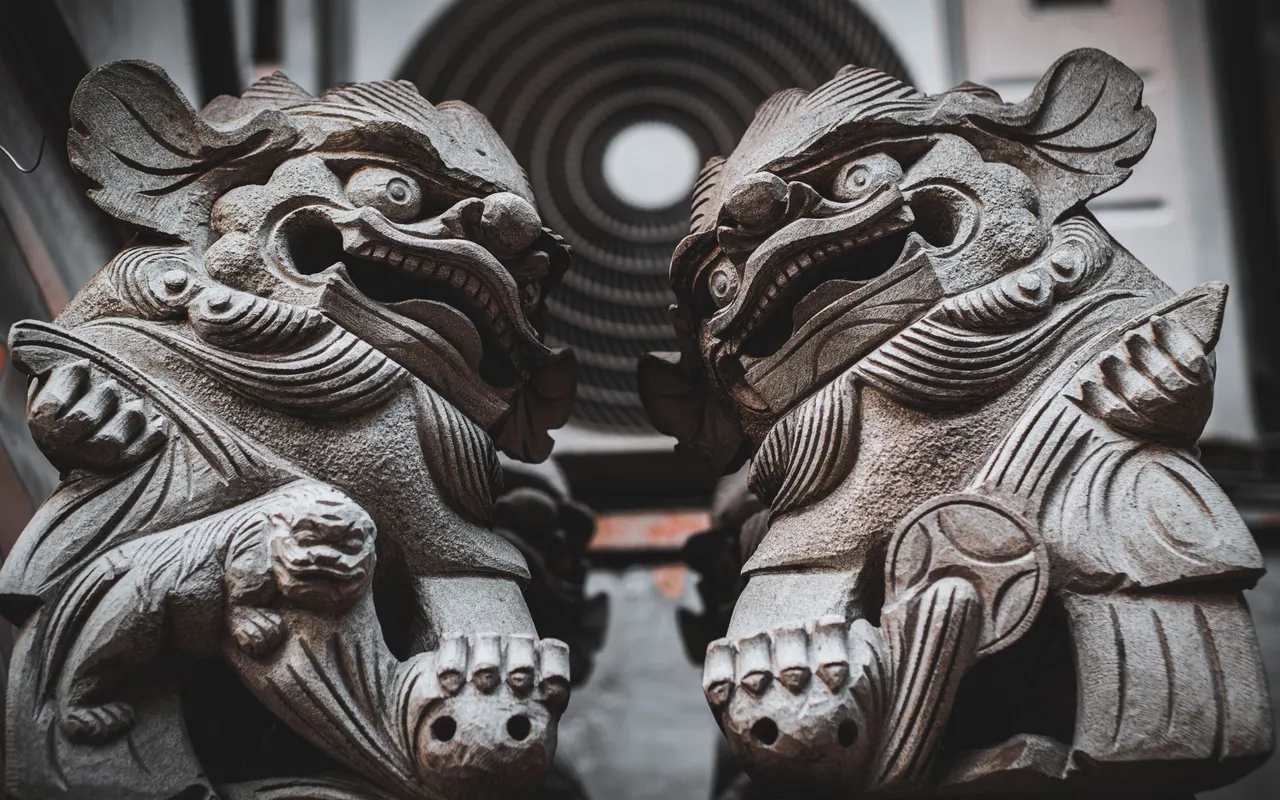
Foo dogs are the pairs of stone or bronze lions you see guarding the gates of Chinese temples, palaces, banks and restaurants. In Chinese they’re simply called stone lions (shishi); the English name “foo dog” probably comes from fo, the Chinese word for Buddha, or fu, meaning good fortune. In feng shui they’re used as protective symbols, and nearly all of the placement advice comes down to one idea: they are guardians, so they belong where a guard would stand.
Getting them right is mostly about three things: which side each lion goes on, which way they face, and keeping them as a pair. Here’s how to do each, including in flats and smaller homes.
Key takeaways
- Foo dogs are guardian lions and are traditionally placed as a pair, one on each side of the main entrance, facing outward.
- The male has a paw on a ball; the female has a paw on a cub. Standing in your doorway looking out, the male goes on your left and the female on your right.
- Indoors, they can sit either side of the door or on a raised surface near the entrance, still facing the door.
- Keep them off the floor where possible, in proportion to the entrance, and out of bedrooms and bathrooms.
- They’re a cultural symbol of protection rather than a guarantee of anything. Treat them with respect and keep them clean and undamaged.
What foo dogs are
Lions aren’t native to China. Knowledge of them arrived through contact with Central Asia and with Buddhism, in which the lion is a protector of the teaching, and Chinese artists developed their own stylised version: curly mane, broad face, powerful chest. Stone lions were placed at tombs by the Han dynasty, and over the following centuries pairs became standard at palace gates, temples, government offices and the houses of wealthy families. Some of the best-known examples are the bronze pairs inside the Forbidden City in Beijing.
A traditional pair is not two identical lions. They are a male and a female, and the difference matters for placement:
- The male rests one paw on an embroidered ball, often explained as representing the world or authority over it.
- The female rests a paw on a cub, representing nurturing and the protection of the people inside.
Together they’re read as a balance of yang and yin: the outward-looking guard and the protector of the household. You’ll often see one with an open mouth and one with a closed mouth. Explanations vary between sources, so I wouldn’t worry about it when choosing a pair.

Japanese shrines have similar guardian figures, the komainu, which look related but follow their own customs. This guide is about the Chinese tradition that feng shui draws on.
The best place: either side of the front door
The classic position is outside the main entrance, one lion on each side, both facing outward toward the street or path. The idea is that they watch who and what approaches and keep harmful energy from entering. This is why you see them at the gates of buildings rather than tucked away inside.
If you’re placing a pair outside, a few practical points help:
- Put them on plinths, low walls or pillars rather than directly on the ground, so they sit at a dignified height.
- Keep them close enough to the door to read as a pair guarding it, but not so close that they crowd the path or block the door opening fully.
- Choose weather-resistant materials such as stone, concrete or metal, and fix heavier pieces securely.
Doors that face a staircase, a wall or a back door bring their own questions, and I cover those in my guide to awkward front door layouts. Guardian lions don’t replace that kind of layout fix; they’re best added once the entrance itself is clear and welcoming.
Which side for the male and the female?
This is where most confusion comes from, because it depends on whether you describe the position from inside or outside the building. The traditional arrangement is:
| Viewpoint | Male (paw on ball) | Female (paw on cub) |
|---|---|---|
| Standing in your doorway, looking out | On your left | On your right |
| Standing outside, looking at the door | On your right | On your left |
Both rows describe the same placement. In feng shui terms, the left side as you look out from a building is the “green dragon” side, associated with yang, so the male sits there; the right side is the “white tiger” side, associated with yin. If you’ve bought a pair and can’t tell them apart, look for the ball and the cub.
Which way should they face?
Foo dogs face away from the home, looking out at what’s coming. That’s true outdoors and indoors. Turning them to face each other, or into the room, goes against their role as guards. A slight inward angle, so each looks diagonally across the approach to the door, is fine and is common at temple gates.
One point of courtesy: in a terrace, a shared corridor or a street where doors face each other, avoid pointing a pair straight at a neighbour’s front door. Protective symbols aimed at someone else’s home can be read as unfriendly, which is the opposite of what you want.
Foo dogs inside the home
Many people live in flats, or simply prefer to keep the lions indoors. That works, with the same principles:
- Just inside the front door: one on each side of the door, or both on a console table or shelf near it, facing the door.
- In a hallway window or on a sill that looks out toward the approach to the home.
- In a living room or home office near the entrance, on a raised surface, facing the door into the room.
Places to avoid are the bedroom, which is meant to be a calm, restful space rather than one on guard, and the bathroom, kitchen and any cluttered corner. If you live in a shared building, check your building’s rules before putting anything in a communal corridor; indoors is usually simpler.
Size, material and choosing a pair
Proportion matters more than size for its own sake. Large stone lions suit a gate or a wide porch, while a small pair on a hall table suits a flat. A rough guide is that the lions should look like they belong to the entrance rather than dwarfing it or disappearing into it.
- Stone and concrete are traditional for outdoor pairs and weather well.
- Brass and bronze suit indoor spaces and bring in the metal element, which compass feng shui associates with the west and northwest. My guide to the northwest and helpful people covers that area of the home.
- Ceramic and resin are lighter and cheaper, fine for indoor use, but check the finish and that both lions are clearly a male and a female.
Buy them as a matched pair, from the same set. Two unrelated lions, or two of the same gender, don’t follow the tradition.
Foo dogs with other protective symbols
Guardian lions are often combined with other symbols at the entrance, but less is usually more. A pair of foo dogs, a well-kept door and good light can be enough. If you’d like to add something, an evil eye charm is one common choice, and my guide to where to hang an evil eye explains its placement. For an overview of how protective, wealth and love symbols are usually placed around the home, see my guide to lucky symbols and where they go.
Foo dogs are about protection rather than wealth, so they don’t belong in the wealth corner. If prosperity is the aim, a money tree or a lucky cat near the entrance is the more usual choice.
Common mistakes
- Separating the pair. One lion on its own, or the two in different rooms, loses the balance the pair represents.
- Putting them the wrong way round. Check the ball and the cub, and the viewpoint table above.
- Facing them into the home. Guards look outward.
- Placing them on the floor in a busy hallway, where they’re kicked, knocked over or used as doorstops.
- Keeping chipped or broken figures. Repair them, or replace the pair.
- Treating them as purely decorative. They’re meaningful cultural objects to many people, so they deserve a considered place, not a spot among clutter.
Looking after foo dogs
Dust indoor pairs regularly with a soft cloth, and clean outdoor stone with water and a soft brush rather than harsh chemicals, which can damage the surface. Clear leaves and debris from around their bases. Some families give their lions a little extra care before Lunar New Year, along with the rest of the spring clean at the entrance.
Frequently asked questions
Which side does the male foo dog go on?
Standing in your doorway looking out, the male (paw on a ball) goes on your left and the female (paw on a cub) on your right. Seen from the street, that’s the male on the right.
Can I put foo dogs inside my home?
Yes. Place them near the front door, on either side of it or on a raised surface nearby, facing the door. Avoid bedrooms and bathrooms.
Should foo dogs face in or out?
Out. They’re guardians, so they face the approach to the home. A slight diagonal angle is fine.
Can I have just one foo dog?
Traditionally they come as a pair, and a single lion isn’t the usual practice. If you only have room for something small, a small matched pair on a shelf is better than one larger figure.
Are foo dogs the same as guardian lions?
Yes. “Foo dog” or “fu dog” is a Western name for the Chinese guardian lion, or stone lion.